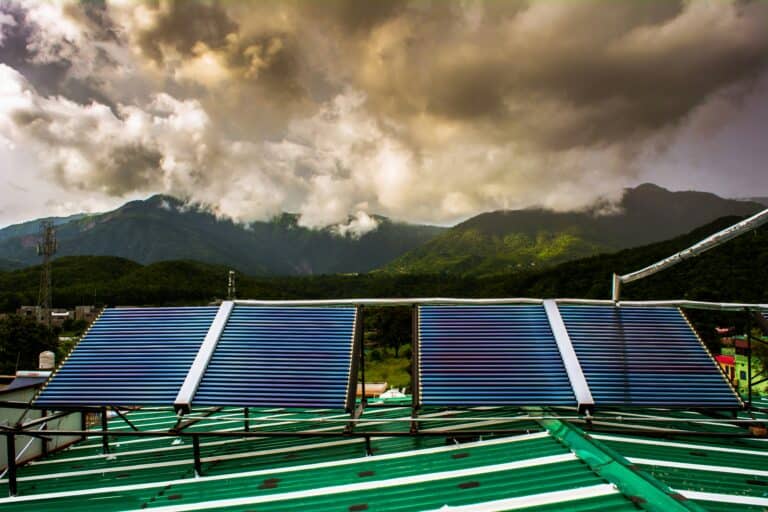
Solar panels usually survive brief contact with floodwater, but the equipment around them often does not, and a submerged array must be treated as live and hazardous until a professional clears it. What happens to solar panels in a flood depends far less on the glass than on what the water reaches underneath. Inverters, combiner boxes, connectors, and grounding are the parts that fail.
A Quick Note
A flooded solar array is an electrical hazard. Panels generate voltage whenever light hits them, and there is no off switch on the panel itself. Do not enter standing water near solar equipment, and do not attempt to inspect or restart a submerged system yourself.
Quick Answer
Panels often come through a flood intact, since they are sealed laminates built for weather. Inverters, connectors, combiner boxes, and batteries are the components that fail. Any submerged system stays electrically live and needs a qualified inspection, including insulation resistance testing, before it goes back into service.
| What the water reached | Likely outcome | What it implies |
|---|---|---|
| Roof array, rain only | No issue. Panels are built for weather. | Nothing to do. Normal operation continues. |
| Ground mount, water to lower frame | Panels generally fine; connectors and grounding suspect | Needs inspection of junctions even if output looks normal. |
| Panels fully submerged | Seal and backsheet integrity in question; moisture ingress possible | Professional testing required. Insulation resistance is the key check. |
| Inverter contacted by water | Usually a replacement, not a repair | Assume it is finished. Do not power it up to test. |
| Battery bank reached by water | Serious hazard, regardless of chemistry | Stay away. Treat as an emergency for a qualified responder. |
| Combiner box or disconnect flooded | Corrosion and tracking faults, often delayed | Problems can appear weeks later. Full replacement is common. |
| Saltwater or sewage exposure | Far worse than clean water at the same depth | Corrosion and contamination usually condemn affected equipment. |
General guidance only. The actual assessment depends on depth, duration, water type, and the specific equipment ratings.
Panels themselves are the most flood-resistant part of a system. They are sealed laminates designed to sit outdoors for decades under rain, hail, and snow. Water on the surface is the condition they were built for, which is why impact events like hail tend to be more damaging than water.
Submersion is a different matter from rain. Panel ingress ratings cover spray and immersion to a limited degree, not sustained time underwater. Edge seals and the junction box on the back are where moisture gets in.
Duration matters as much as depth. A few minutes under moving water is a very different exposure from several days in a static pond, because time is what lets moisture work past a seal.
Water quality is the third variable, and it is often decisive. Clean river water, salt water, and sewage leave different residues behind, and two of those three cause lasting corrosion and contamination.
Why Submerged Panels Stay Dangerous
A solar panel produces voltage whenever light reaches it, with no way to switch it off at the module. Flooding does not change that, and a string of panels can carry a voltage high enough to be lethal.
Water makes it worse by providing a conductive path to ground. A fault that would be contained in dry conditions can energize surrounding water or metalwork.
Covering panels with opaque material is the only way to reduce their output, and that is a job for someone equipped to do it safely. Understanding how an array is properly shut down shows why a breaker alone does not make modules safe.
What Actually Fails After Floodwater Recedes
Inverters are the usual casualty. They hold electronics, capacitors, and cooling paths that water ruins, and a flooded inverter is generally replaced rather than dried out and returned to service.
Connectors are the sneaky failure. Submerged connectors admit moisture that corrodes the contact surfaces, and the resulting resistance shows up as heat later. That delayed pattern is one of the entries in why output drifts below where it should be.
Grounding and bonding deserve specific attention. Corrosion at a ground connection removes the safety path exactly when faults become more likely, and why grounding matters applies with more force after a flood than before one.
How a Flooded System Gets Assessed
A qualified assessment starts with isolation, then moves to insulation resistance testing on each string. That test is what reveals moisture inside a laminate, which no visual check can find.
Visual inspection still matters for the obvious things. Delamination, clouding behind the glass, corrosion staining at frames, and discoloration in a junction box are all visible warnings.
Output testing comes last and proves less than people expect. A panel can test near its rated output while carrying moisture that will fail it within a year. Checking performance with a multimeter on a single panel is useful context but not a clearance.
Warranty and Insurance After a Flood
Manufacturer warranties cover defects, not flood damage. A panel that fails because it sat underwater is outside what the product warranty promises, and what a panel warranty actually covers makes that boundary clear.
Property insurance is where a flood claim belongs, and flood coverage is frequently a separate policy from standard homeowners cover. Whether a roof-mounted array is treated as part of the dwelling or as separate equipment affects how it is handled.
Documentation is the part you control. Photograph water levels, equipment, and serial numbers before anything is moved or replaced. How solar interacts with home insurance is worth settling before an event rather than during one.
Reducing Flood Exposure in the First Place
Roof arrays are inherently safe from flooding, which is one quiet advantage of roof mounting in a flood-prone area. The exposure sits with ground mounts and with equipment placed low.
Mounting height is the main lever on a ground array. Raising the lower edge above the expected flood level protects both the modules and their wiring, and ground mount racking choices determine how much height is available.
Equipment placement matters just as much. Inverters, combiners, and battery enclosures mounted well above grade survive events that destroy the same hardware at floor level. Watching for the early signs afterward is covered in what a failing panel looks like, since flood damage frequently announces itself months later.
Worth reading alongside this: the hail article covers the other major weather threat to modules, and the warranty breakdown explains where manufacturer liability stops. For ground arrays specifically, racking height is the single decision that determines flood exposure.
Frequently Asked Questions
What happens to solar panels in a flood if they are only briefly submerged?
Short submersion in clean water often leaves the modules serviceable, but that cannot be assumed without testing. Insulation resistance testing on each string is what establishes whether moisture got inside. Connectors and junction boxes need inspection regardless of how the panels test.
Can you turn off a flooded solar array?
Not completely. Panels generate voltage whenever light reaches them, and no breaker stops that at the module. Disconnects isolate the array from the rest of the system, which is not the same as making the panels safe to touch.
Does a flooded inverter need replacing?
Almost always. Water damages electronics, connections, and cooling paths in ways that drying does not reverse. Attempting to power up a flooded inverter risks further damage and a fire, so it should not be energized.
Is saltwater worse than freshwater for solar equipment?
Considerably worse. Salt is conductive and aggressively corrosive, so it attacks contacts, frames, and grounding hardware long after the water has gone. Equipment exposed to saltwater is usually condemned where the same depth of clean water might not condemn it.
Will insurance cover flood damage to solar panels?
That depends on your policy, and flood cover is often separate from standard homeowners insurance. How the array is classified, as part of the dwelling or as separate equipment, also affects the outcome. Confirm both points with your insurer before an event.
How soon do flood problems show up?
Some appear immediately, such as a dead inverter. Corrosion-driven faults often take weeks or months, as resistance builds at affected contacts. That delay is why post-flood monitoring matters even when a system restarts normally.
Who should inspect a flooded system?
A licensed electrician or qualified solar technician with the right test equipment. The work involves isolating live strings and performing insulation resistance testing, neither of which is a homeowner task. Arrange that inspection before the system is returned to service.