
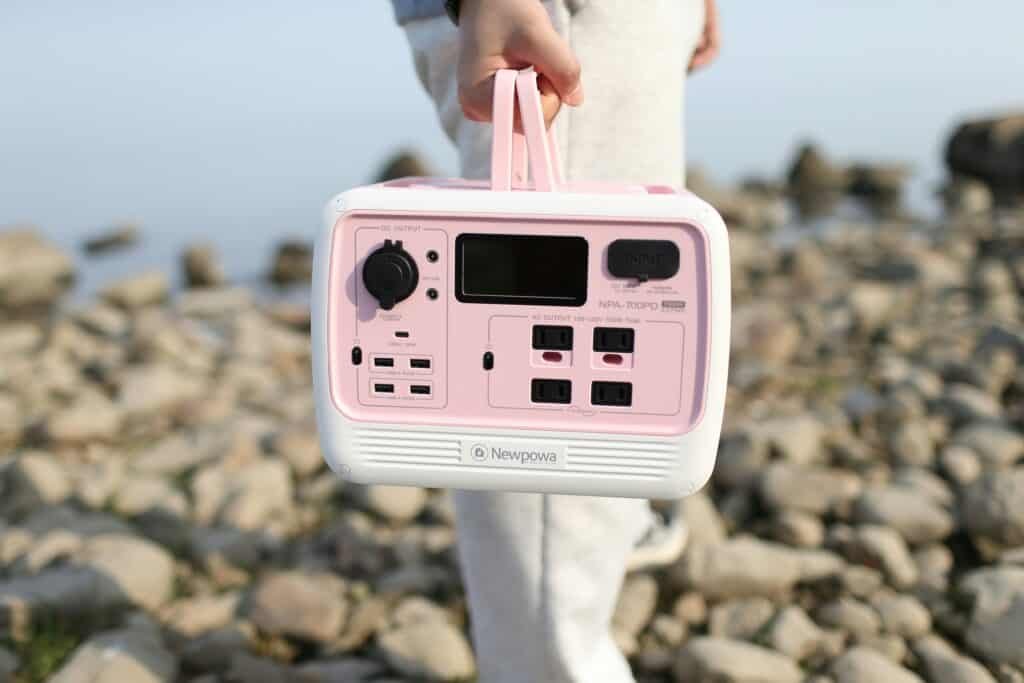
Almost no portable power station can legally fly, because airline lithium battery rules cap what passengers may carry at a capacity far below what any real power station holds. Asking can you take a portable power station on a plane usually ends in the same answer. The watt-hour rating on the case is the number that decides it, and most units sit well past the ceiling.
The limits are built around fire risk in a sealed cabin, not around size or weight. That is why a unit you could lift easily is still refused, while smaller solar power banks travel without a second look.
Quick Answer
No, not in practice. Lithium batteries above 160 watt hours are barred from both cabin and checked baggage on passenger flights. Units between 100 and 160 watt hours need airline approval and must travel in the cabin. Nearly every power station exceeds both thresholds by a wide margin.
Key Takeaways
- Watt hours, not amp hours or physical size, is the figure airlines and regulators use.
- Under 100 watt hours travels freely in carry-on. Between 100 and 160 watt hours needs prior airline approval.
- Above 160 watt hours is not permitted in passenger baggage at all, cabin or hold.
- Spare lithium batteries always ride in the cabin, never in checked bags, regardless of size.
- Ground shipping or renting at the destination is the realistic path for anything larger.
| Battery capacity | Carry-on | What it means in practice |
|---|---|---|
| Under 100 watt hours | Allowed, no approval needed | Phone banks and small laptop banks. Keep them in the cabin. |
| 100 to 160 watt hours | Allowed with airline approval | Large laptop banks and a few of the smallest power stations. Ask before you book. |
| Above 160 watt hours | Not permitted | This covers essentially every product sold as a power station. |
| Any capacity, checked bag | Spare batteries not permitted | Lithium packs belong in the cabin so crew can reach them. |
| Medical device battery | Exemptions may apply | Rules differ for medical use. Clear it with the airline well in advance. |
| Damaged or recalled pack | Not permitted at any size | A swollen case or a recall notice disqualifies a unit outright. |
| Unlabeled capacity | Expect refusal | If staff cannot read the rating, the safe assumption is that it fails. |
General framework only. Individual airlines apply stricter policies, and rules differ by country and by route.
Why Watt Hours Is the Number That Matters
Airline rules are written in watt hours because that figure describes stored energy, which is what drives fire severity. Physical size and weight are irrelevant to the thresholds.
Most power stations print the watt-hour rating on the case or in the spec sheet. Where only amp hours and voltage appear, multiplying the two gives watt hours. That conversion is the same arithmetic covered in turning milliamp hours into watt hours.
The gap between the limit and real products is large. A unit sized to run a laptop and some lights for a weekend holds many times the 160 watt-hour ceiling. Even the smallest models in the category usually clear it.
What Actually Happens at Security and the Gate
Screening looks for lithium packs, and a power station is unmistakable on a scanner. A unit over the limit gets pulled, and the outcome is usually surrender rather than a return trip to the car.
Checked baggage is not a workaround. Spare lithium batteries are specifically barred from the hold, because a fire there cannot be reached by crew. That rule applies regardless of capacity.
Carrying a unit with an unreadable or missing label invites refusal. Agents cannot verify a rating they cannot see, and the default decision goes against the passenger. Keeping the original markings intact is worth more than it sounds.
Approval for the middle tier is arranged with the airline, not with security. A passenger who turns up expecting to negotiate at the checkpoint has already missed the step that mattered. Secure that agreement in writing when you book, and carry a copy.
The Options That Do Work for Air Travel
Staying under 100 watt hours is the clean solution when the need is modest. That capacity covers phone charging, camera batteries, and a laptop top-up, which is the realistic demand on most trips.
Several battery banks sit just below the threshold deliberately, since manufacturers know the rule. Reading the rating before buying is the whole trick. Working through what a power station actually runs helps separate a genuine need for one from a need for a large bank.
Where a real power station is needed at the destination, ground shipping it ahead works for domestic trips. Lithium shipments have their own packaging and labeling requirements, so the carrier’s rules govern. Renting locally skips the problem entirely.
Driving, Rail, and Other Travel Compared
Road travel has no equivalent restriction, which is why power stations suit car camping so well. A unit secured against sliding and kept out of direct sun travels fine.
Rail and long-distance bus policies vary by operator and are generally far more permissive than air. Checking the specific carrier is still worthwhile on international rail.
Boats and ferries usually allow them, with the usual care about moisture and secure stowage. For any of these, the maintenance side matters more than the paperwork, and keeping a unit healthy between trips covers the storage state that extends its life.
Choosing a Unit When Travel Is Part of the Plan
If flights are a regular part of how you travel, the capacity question should come before the feature list. A compliant bank plus a folding panel often beats a power station that cannot leave the ground.
For mixed use, two devices sometimes make more sense than one. A small bank flies, and a larger unit stays with the vehicle. Thinking through how to pick a power station against that split avoids buying the wrong size twice.
Budget matters here too, since a flight-legal bank is a much smaller purchase. The lower end of the power station market still sits above the air limit, so there is no cheap way around it.
Related Reading
Capacity planning is the thread that connects this to the rest of the category. Knowing how long these units last shapes whether a second smaller device is worth owning. For builds that grow over time, expansion batteries are the alternative to replacing a unit outright.
Frequently Asked Questions
Can you take a portable power station on a plane in checked baggage?
No. Spare lithium batteries are barred from checked baggage entirely, because a fire in the hold cannot be reached by the crew. Putting a power station in a suitcase does not get around the capacity limit, it breaks a separate rule.
What is the largest battery you can bring on a flight?
Up to 100 watt hours needs no approval and rides in the cabin. Between 100 and 160 watt hours is allowed with the airline’s prior agreement. Anything above 160 watt hours is not permitted in passenger baggage.
How do you find a power station’s watt-hour rating?
It is usually printed on the case or the label alongside the model number. If only amp hours and nominal voltage are listed, multiply them to get watt hours. Keep the label readable, since an agent who cannot verify the figure will refuse the unit.
Can you ship a power station instead of flying with it?
Ground shipping is generally the workable route, subject to the carrier’s lithium battery packaging and labeling rules. Air freight faces restrictions of its own. Confirm requirements with the carrier before packing, since mislabeled lithium shipments get rejected.
Do solar panels have the same restrictions?
Folding solar panels hold no battery, so they are not subject to lithium rules. They travel as ordinary luggage, with size and fragility being the only real concerns. A panel plus a compliant bank is a common flight-friendly pairing.
Are the rules different for international flights?
The watt-hour thresholds come from international air transport guidance, so the framework is broadly consistent. Individual airlines and national regulators can and do apply stricter limits. Check the specific carrier for every leg of the trip.
What about a power station for a medical device?
Medical use can qualify for exemptions, but these are arranged with the airline ahead of time rather than at the gate. Documentation and advance notice are usually required. Start that conversation well before the travel date.