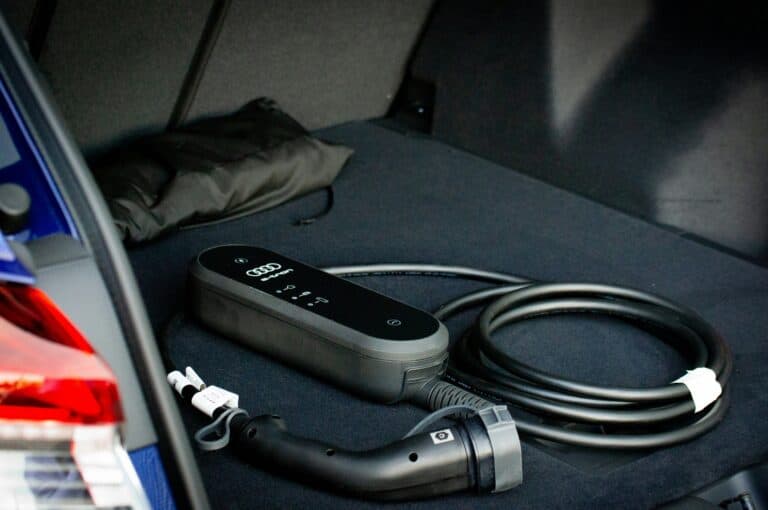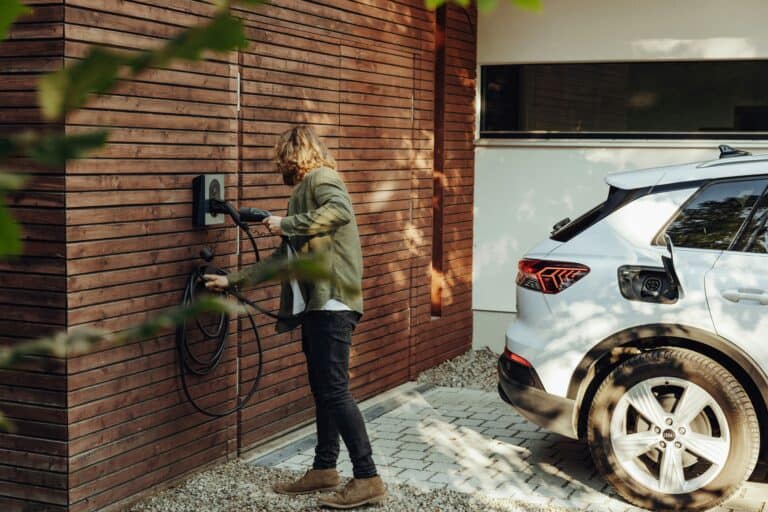

The fastest way to ruin an EV charging connector is to let it sit on the garage floor. EV charging cable organizers exist because the cable itself is heavy, stiff, and reluctant to coil the way anyone wants. Left alone, it slumps across the concrete and drags every time the car pulls out.
That dragging is the real damage. Grit works into the connector pins, moisture follows the grit, and contact resistance climbs. Charging electronics rarely fail first, because the connector usually gets there ahead of them.
A good organizer solves a mechanical problem, not an electrical one. It holds weight, keeps the head elevated, and gives the cable a predictable path back to the wall. Anyone already thinking about tidy cable runs around the house will recognize the same logic applied to a much heavier cord.
Quick Verdict
A wall-mounted holster suits most garages because it fixes the one failure that matters: a connector resting in grit. Retractable reels help where floor space is tight, though cold weather slows them. Overhead pulleys win in garages where parking direction changes, and weatherproof covers matter outdoors rather than indoors.
Key Takeaways
- The connector is the expensive component, so keeping its head off the ground protects the part most likely to fail.
- Cable weight, not cable length, decides what kind of mount a garage wall can carry safely.
- Drywall anchors flex under a loaded cable, while a stud or masonry fixing holds without creeping.
- Cold stiffens insulation, which makes retractable reels slower and harder to work in winter.
- Overhead systems clear the floor completely and forgive cars that park nose-in one day and reversed the next.
- Magnetic docks add convenience but carry none of the cable weight, so pair them with real support.
How We Picked
This guide is research-based. Product categories here were compared by reading manufacturer documentation, installation instructions, owner discussions, and long-run reports from people who charge daily in varied climates.
Category selection came first. Six mounting approaches cover almost every garage, carport, and driveway, so each section describes a type of solution rather than a brand.
Failure patterns shaped the ranking more than features did. Cracked plastic, sagging anchors, and connectors resting in water recur constantly, so designs that avoid them ranked higher.
Climate got specific weight, because sun, frost, and blowing dust change which materials survive.
1. A Wall-Mounted Cable Holster, Best Overall
Why It Stands Out
A holster does one job well. It cradles the connector head at chest height, so the pins never touch concrete, salt, or standing water.
The cable then loops from the holster in a wide arc rather than a tight pile. Wide arcs matter, because sharp bends stress the jacket where it enters the connector body.
Better designs add a lip or shroud that keeps dust off the contact face between sessions.
Worth Knowing
Substrate decides everything here. A loaded cable pulls down and outward at once, twisting hard against whatever holds the plate to the wall.
Drywall anchors alone tend to loosen over months of daily tugging. A stud fixing or masonry sleeve removes that worry, and the same care applied to sealed cable entries through an exterior wall applies to any load-bearing mount.
Material matters outdoors. Plastic that lives in direct sun goes brittle, so UV-stable polymer or coated metal lasts far longer on a sunlit wall.
A wall holster fits drivers with a fixed parking spot and a solid wall near the charger. Skip it if the wall is hollow-clad with nothing behind it, or if the car parks differently each night.
2. A Retractable Cable Reel, Best for Tight Garages
Why It Stands Out
A reel removes the coiling decision entirely. The cable pays out when pulled and returns on a spring or a hand crank when released.
That suits narrow garages where a hanging loop would brush a door or a workbench. Nothing rests on the floor, so nothing gets rolled over.
Reels also enforce a consistent bend radius, which is gentler than the flat kinks a cable takes when stepped on.
Worth Knowing
Winter changes the experience. Cold makes the insulation stiff and the spring sluggish, so a reel that glides in July can fight back in January.
Heated garages sidestep most of that. Unheated ones suit a manual crank version, which trades convenience for control that ignores temperature.
Reels are also the heaviest option on this list once loaded. Mount them into structure, never into a hollow panel, and treat the fastener spec the way an installer treats a torque figure on a critical terminal.
A reel suits drivers who want the cable gone the moment charging ends, in a garage too tight for a hanging loop. Skip it in a cold outbuilding, or where the surface cannot take concentrated weight.
3. An Overhead Ceiling Pulley System, Best for Flexible Parking
Why It Stands Out
An overhead system drops the cable from above and clears the floor completely. Nothing to trip over, nothing to run a tire across.
The real advantage is direction. A cable hanging from the ceiling reaches a charge port on the left or right, front or rear, without any rerouting.
That flexibility helps households where the car parks nose-in one day and backed in the next, or where two vehicles have ports on opposite sides.
Worth Knowing
Ceiling structure is the whole story. Joists carry this load easily, while ceiling board does not, so locate framing before drilling.
Height needs a moment of thought too. The connector should hang above head height when parked, yet drop within easy reach when pulled down.
Pulley and counterweight systems benefit from a smooth glide path. Rough hardware chews the cable jacket, and clean routing matters as much here as it does on any long outdoor cable run.
Overhead setups suit multi-car garages and anyone whose parking position varies. Skip them in low-clearance spaces, or where the ceiling has no accessible framing.
4. A Magnetic Connector Dock, Best for Quick Parking
Why It Stands Out
A magnetic dock gives the connector a home without a cradle to aim at. The head snaps into place one-handed, even in poor light.
That speed suits people who want the routine over in seconds. No twisting, no threading, no fiddling with a clip.
Docks also stay compact, occupying a small footprint on a wall or a post.
Worth Knowing
A magnet holds the head and nothing else. The cable weight still hangs somewhere, usually on the connector body or the floor below it.
Pairing a dock with a hook or hanger fixes that gap. One item holds the head, the other carries the loop, and neither works as hard alone.
Magnet strength also drops as temperatures swing and dust builds on the contact face. A quick wipe keeps the hold consistent, much like keeping connector faces clean before mating them.
Docks suit drivers who value speed and already have cable support elsewhere. Skip a dock as a standalone solution, because it does nothing for the weight problem that causes most wear.
5. A Cable Hook and Hanger Set, Best on a Budget
Why It Stands Out
Hooks are the simplest fix that works. Two or three carry the loop, and the connector rests on the highest one.
Simplicity brings reliability. Nothing weakens, seizes, or freezes in winter.
Spreading the load across several hooks also reduces the strain on any single fastener.
Worth Knowing
Hook profile matters more than it looks. Broad, rounded hooks support the cable jacket, while thin metal ones create pressure points that mark the insulation.
Spacing controls the shape of the coil. Hooks placed too close force a tight loop, and tight loops fatigue the cable where it bends most.
Rated hooks and correct anchors still apply. Treat the install like any load-bearing job and label the setup clearly if the garage has other equipment, in the same spirit as clear labeling on a home power system.
Hooks suit renters, first-time EV owners, and anyone testing a layout before committing. Skip them if the goal is a fully floor-free garage, since the loop still hangs in the room.
6. A Weatherproof Connector Cover, Best for Outdoor Chargers
Why It Stands Out
Outdoors, the connector faces rain, road salt, insects, and dust. A cover shields the contact face while the cable sits idle.
Keeping water out of the pins prevents corrosion that no amount of wiping reverses later.
Many designs also block direct sun. Shade slows the aging of a connector housing that sits in daylight all summer.
Worth Knowing
A cover is not a substitute for a holster. It protects a connector that is already held properly, and it does nothing for one lying in a puddle.
Material choice decides lifespan. UV-stable rubber or coated fabric survives outdoor seasons, while cheap plastic cracks after a summer of sun.
Drainage deserves a check as well. A cover that traps condensation can hold moisture against the pins, so look for designs that vent or shed water, and consider a lockable option where equipment sits in the open.
Covers suit outdoor and carport chargers in any real climate. Skip one in a dry, enclosed garage where dust is the only threat.
Cable Organizers at a Glance
| Type | Best For | Mounting Demand | Main Limitation |
|---|---|---|---|
| Wall-mounted holster | Fixed parking spot, daily charging | Stud or masonry fixing | Cable loop still hangs on the wall |
| Retractable reel | Narrow garages, fast cleanup | Heaviest load, structure required | Stiff and slow in cold weather |
| Overhead pulley | Changing park direction, two cars | Ceiling joist fixing | Needs generous clearance overhead |
| Magnetic dock | Speed and one-handed docking | Light, small footprint | Carries no cable weight at all |
| Hook and hanger set | Budget setups and rentals | Multiple light anchors | Floor stays partly occupied |
| Weatherproof cover | Driveway and carport chargers | None, fits over connector | Not a replacement for a holster |
What to Look For in a Cable Organizer
Will the Wall Actually Hold It?
Weight is the deciding factor, and a charging cable weighs more than most people expect. Every pull adds strain at the fastener, which slowly works a drywall anchor loose.
Find a stud, use a masonry sleeve, or fit a backing board across two studs. That choice separates a mount that lasts years from one that sags by spring.
Does It Keep the Head Off the Ground?
A connector resting on concrete collects grit, and grit in the pins raises resistance and heat over time.
Look for a cradle that holds the head fully, not one that lets it dangle. Height should sit within easy reach yet above any water that pools.
How Does the Cable Bend?
Sharp bends fatigue the jacket, especially right at the connector strain relief. Wide, gentle loops age far more slowly.
Rounded hooks, broad cradles, and generous drum diameters all help, while anything that forces a tight kink shortens cable life.
Will the Material Survive the Location?
Indoor garages are forgiving, and basic polymer holds up fine in shade. Outdoor installs are harsher, since sunlight embrittles ordinary plastic quickly.
UV-stable polymer, powder-coated steel, and stainless fasteners handle exposure much better.
Holster vs Retractable Reel
When the Holster Wins
A holster costs less, installs faster, and has nothing inside it to break. It also works identically at every temperature, which matters in an unheated garage.
Drivers with one parking spot and a solid wall rarely need more, since the connector stays clean and the loop stays clear of the floor.
When the Reel Wins
A reel earns its price where floor and wall space are genuinely scarce. It swallows the whole cable instead of leaving a loop in the room.
It suits households that charge daily and want a fast cleanup. Just plan for slower winter retraction and a mount into real structure.
What Trips People Up
Mounting Into Drywall Alone
This is the most common regret. Plastic anchors hold at first, then repeated pulling enlarges the hole and the bracket tilts.
Once a mount tilts, the connector slides toward the floor. Fixing into framing from the start avoids the whole sequence.
Mounting Too Low
A holster placed at waist height keeps the connector out of the worst grit but still within reach of splash and dust. Water on a garage floor migrates further than expected.
Higher placement also shortens the hanging loop, which keeps it clear of tires and shoes.
Ignoring Cold Weather
Buyers judge a reel in mild weather, then get surprised in January. Stiff insulation resists winding, and the spring fights colder grease.
A manual crank or a plain holster sidesteps the issue completely.
Treating a Cover as a Holster
Covers protect a connector that already sits properly supported. Draped over a head resting in a puddle, a cover traps moisture rather than excluding it.
Use both outdoors, in the right order. Support first, then protection.
Recommended Reading
- portable power add-ons worth owning
- lighting a detached garage without wiring
- motion lighting for a driveway approach
- picking a starter kit for a detached space
- sizing heavy cable and lugs correctly
Frequently Asked Questions
Do EV charging cable organizers really extend cable life?
They extend connector life more than cable life, and the connector is the costly part. Keeping the head off the floor stops grit from working into the pins, which is the failure most owners eventually meet. Organizers also prevent tires from rolling over the cable, which crushes insulation in a way no repair fixes.
What is the safest way to mount a holster on a garage wall?
Fix into a stud, into masonry with proper sleeves, or into a backing board spanning two studs. A loaded cable pries at the fastener every time it is pulled, and hollow-wall anchors gradually enlarge their own holes. Stainless or coated fasteners are worth using on any wall that sees damp.
Are retractable reels worth the extra cost?
They are, in garages where space is genuinely tight and cleanup speed matters daily. Reels remove the hanging loop entirely and enforce a consistent bend radius. In cold, unheated spaces they lose some of that advantage, because stiff insulation and cold grease slow retraction noticeably.
Can a magnetic dock hold the cable by itself?
A magnet holds the connector head, not the cable behind it. The remaining weight ends up on the connector body or on the floor, which defeats the purpose. Pair a dock with hooks or a holster so something is actually carrying the loop.
Does an overhead pulley suit a low garage ceiling?
Low ceilings make overhead systems awkward, since the connector needs to clear head height when parked. Standard garages usually have room, while converted or low-clearance spaces often do not. Measure from the floor to the joist before buying, and confirm the framing is reachable.
What material lasts longest for an outdoor install?
UV-stable polymer, powder-coated steel, and stainless hardware handle sun and rain well. Untreated plastic is the usual disappointment, because sunlight embrittles it and small cracks spread outward from the fastener holes. Shade slows that process, though material choice matters far more than placement does.
Is a weatherproof cover necessary in a closed garage?
Indoors it is optional, since rain and salt are absent and dust is the only concern. A holster with a shroud usually handles that on its own. Outdoors the calculation flips, and a cover becomes one of the cheapest protections available for the connector.