Fence charger sizing runs on joules of output energy, not on the mile ratings printed on the box. Those mile figures assume clean wire with no vegetation touching it, which describes no fence anyone actually owns. Buying on stored joules and allowing headroom for grass contact is how you end up with a fence that still works in August.
| Output joules | Realistic fence length | Suits |
|---|---|---|
| 0.1 to 0.5 J | Under half a mile | Poultry, pets, garden protection |
| 0.5 to 1 J | Half to one mile | Horses, small paddocks, goats |
| 1 to 2 J | One to three miles | Cattle, rotational grazing |
| 2 to 4 J | Three to eight miles | Large herds, mixed vegetation |
| 4 J and above | Eight miles plus | Extensive systems, heavy brush |
| Any rating | Halve it for weedy fence | Every real installation |
Animal type matters as much as distance. A hair coat conducts differently from wool, so sheep need more energy than cattle over the same fence length, and pigs need less than either because their noses make excellent contact. Getting this wrong produces a fence that technically works and that animals learn to walk through.
What We Weighed
Stored joules against output joules came first, because manufacturers quote whichever is larger. Output joules is what reaches the animal, and it is always the smaller number.
Battery and panel sizing mattered next. A charger that runs down over a week of overcast weather leaves stock unfenced, and winter is when most solar fence units fail.
Weather sealing ruled out several designs. These sit in a field year-round, taking rain, frost, and direct sun, and a poorly sealed case fails within a season.
We included the accessories that decide whether a system works, since a good charger on bad grounding produces a fence that does nothing.
Low-Output Solar Charger
Why It Stands Out
Sized for garden protection, poultry netting, and pet containment, where a short run and light vegetation mean high output is unnecessary. Compact enough to move between locations easily.
The small panel and battery also mean these recover quickly and stay charged even in shorter winter days, since the load is modest.
Worth Knowing
Low output has no tolerance for vegetation. Grass touching the wire drains a fraction of a joule quickly, so these need the fence line kept genuinely clear.
They are also unsuitable for anything with a thick coat. Sheep and heavily furred animals need more energy than this class delivers.
Best for poultry netting, garden protection, and containing dogs or small livestock over short runs. Skip for cattle, sheep, or any fence line you cannot keep clear.
Mid-Range Solar Fence Energizer
Why It Stands Out
The general-purpose choice for horses, goats, and small to medium paddocks. Enough output to cope with some vegetation contact without the cost and physical size of a high-joule unit.
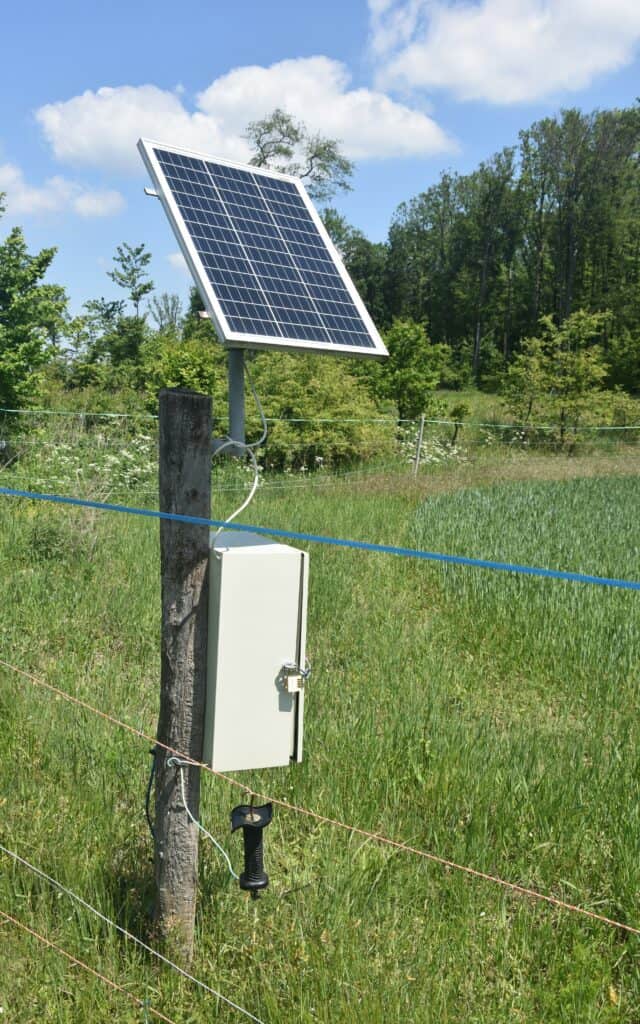
This is also the class where integrated designs work well, combining panel, battery, and energizer in one weatherproof housing mounted on a single post.
Worth Knowing
Integrated units mean the panel faces wherever the post faces. Where shade is a factor, a separate panel gives you options the all-in-one design does not.
Battery replacement on sealed units varies from straightforward to impossible depending on the model, and that determines whether the unit lasts five years or fifteen.
Best for horse paddocks, goat enclosures, and rotational systems under a mile. Skip for large herds or fence lines running through heavy brush.
High-Joule Solar Charger
Why It Stands Out
Built for long runs and difficult conditions, with enough stored energy to push through vegetation contact that would flatten a smaller unit. For extensive grazing systems this is the class that works rather than the one that nearly works.
Higher output also means the fence stays effective as the season progresses and growth encroaches, rather than needing constant clearing to remain functional.
Worth Knowing
These need a substantially larger battery and panel, which makes them heavier and less portable. Moving one between paddocks is a two-person job.
High output demands correspondingly good grounding. Undersized earthing wastes most of what the unit produces, and that is where high-joule installations most often disappoint.
Best for cattle, large acreage, brushy fence lines, and anywhere vegetation cannot be kept off the wire. Skip for small paddocks, where the capacity is wasted and the price is not.
Separate Panel Fence Charger Kit
Why It Stands Out
Splits the panel from the energizer, so the panel goes where the sun is while the unit sits wherever suits the fence. In wooded or north-facing sites this solves a problem integrated units cannot.
Separate panels are usually larger too, which means faster recovery after cloudy stretches and better winter performance.
Worth Knowing
More components means more to mount, more to wire, and more to fail. The cable between panel and unit needs protecting from stock, machinery, and rodents.
You also need to match panel output to the charger’s battery, and mismatched pairings either undercharge or need a controller. Guidance sits in choosing a charge controller.
Best for shaded sites, permanent installations, and anyone wanting to size the panel independently. Skip if you move the fence regularly or want the simplest possible setup.
Grounding Rod Kit
Why It Stands Out
The single component that decides whether a fence works, and the one most people underspend on. Current has to return through the soil to the ground rod, and inadequate earthing means the animal never completes the circuit properly.
Multiple rods spaced apart do far more than one long rod, since what matters is soil contact area rather than depth alone.
Worth Knowing
Dry and sandy soils conduct poorly, which means more rods rather than a bigger charger. This is the fix when a fence tests weak despite adequate output.
Ground rods must sit well away from building earths and buried utilities, and that spacing requirement catches people out on smaller properties.
Best for every installation, and especially high-joule systems and dry soils. There is no situation where skipping this improves anything.
Fence Voltage Tester
Why It Stands Out
Tells you whether the fence is actually live and at what voltage, which is the difference between diagnosing a fault and guessing at it. A fence that reads low points at vegetation, grounding, or a broken wire, and the reading narrows it down.
Digital testers show a number rather than a row of lights, which lets you track gradual decline before stock notice it.
Worth Knowing
Testers need their own battery and get left in sheds. A unit stored somewhere useless does not get used, which is the main reason fences go unchecked.
Readings vary along the fence line, and testing only at the charger misses faults further out. Walking the line with the tester is the actual technique.
Best for anyone running electric fencing at all, and especially long runs where faults are hard to locate. There is no reason to skip one.
What to Look For
Output joules, not miles
Mile ratings assume perfectly clean wire. Output joules is the specification that survives contact with reality, and doubling your calculated requirement covers vegetation growth through the season.
Animal type before fence length
Coat thickness changes how much energy reaches the animal. Sheep and heavily coated stock need considerably more than cattle over the same distance, and pigs need less.
Battery capacity for cloudy stretches
A charger should hold enough to run through several overcast days. This matters most in winter, and it is where cheap units fail while their specifications look fine.
Serviceable batteries
The battery will fail before the electronics. A unit with a replaceable battery lasts three times as long as a sealed one, and that difference dwarfs the purchase price gap.
Solar Against Mains-Powered Chargers
The case for solar
Goes anywhere, including fence lines nowhere near a building. No cable runs, no trenching, and the unit moves with a rotational grazing system rather than dictating where the fence goes.
The case for mains
Consistent output regardless of weather or season, no battery to degrade, and generally more joules per pound spent. Where a fence sits near a building with power, mains is the more reliable answer, and solar earns its place through location rather than performance. Sizing considerations sit in battery sizing.
Common Mistakes to Avoid
Undersizing the ground system
More installations fail on grounding than on charger output. Multiple rods, properly spaced, in the moistest soil available, and away from building earths.
Letting vegetation touch the wire
Every point of contact bleeds energy to ground. A charger sized with no headroom works in spring and fails by midsummer as growth reaches the lowest wire.
Mounting the panel facing the wrong way
Integrated units get positioned for fence convenience rather than sun. Orientation matters as much here as on a roof, covered in panel orientation.
Never testing the fence
Stock discover a dead fence faster than owners do. A weekly walk with a tester catches faults while they are still small, and unexplained voltage drops usually trace to a single point of contact.
Worth reading next: solar gate openers covers the other end of a fenced property, solar well pumps handles stock water, cold weather battery behavior explains winter drop-off, 12V batteries covers replacements, and 100 watt panels suits anyone building a separate-panel setup.
Frequently Asked Questions
What size solar fence charger do I need?
Work from output joules rather than mile ratings, and roughly double your calculated requirement to allow for vegetation contact. Animal type matters too, since heavily coated stock need more energy than cattle over the same distance.
How many joules for cattle?
Around one to two joules covers most cattle setups up to a few miles of fence, with more needed for brushy lines or larger acreage. Grounding quality affects the result as much as the charger rating does.
Do solar fence chargers work in winter?
They work with reduced charging, since shorter days and low sun angle cut panel output while cold reduces battery capacity. Units with generous battery capacity relative to output cope best with overcast stretches.
Why is my electric fence not working?
Grounding is the most common cause, followed by vegetation touching the wire and broken conductors. A voltage tester walked along the line locates the fault far faster than inspecting the charger.
How many ground rods do I need?
More than most installations have. Multiple rods spaced several feet apart in the moistest soil available, and dry or sandy ground needs additional rods rather than a larger charger.
Can one charger power multiple fences?
Yes, provided total wire length and vegetation load stay within its output. Splitting a system across paddocks adds length, so size for the total rather than the longest single run.
Should the charger stay on year round?
Generally yes where stock are present, since animals test fences they believe are off. Leaving a solar unit running also keeps the battery cycling, which suits it better than sitting flat over winter.