Two genuinely different products get sold under the same name here, and they solve two different problems. A folding solar panel charges your devices while the sun is actually out. A solar power bank stores charge and then delivers it back to you whenever you want it.
The distinction matters a great deal, because the built-in solar panel on most power banks is close to decorative. Our roundup of foldable solar panels covers the larger panels.
Types at a Glance
| Type | Best for | Limitation |
|---|---|---|
| Folding panel, 20W+ | Actually charging a phone in daylight | Needs sun and orientation |
| Folding panel with power bank | Charge by day, use at night | Two things to carry |
| Solar power bank | Emergency top-up only | Built-in panel is very small |
| Small clip-on panel | Trickle charging while hiking | Slow, shaded by your body |
| Panel with built-in battery | Simplicity, one item | Heavier, fixed capacity |
| Hand crank hybrid | Genuine emergency backup | Very low output for effort |
How We Picked
Selections are grouped by whether the device generates meaningful power or merely stores it, since that is the distinction most listings blur.
Descriptions come from documented specifications rather than hands-on evaluation of every option.
1. A Folding Panel Around 20 to 30 Watts, Best Overall
Why It Stands Out
Enough surface area to charge a phone at a useful rate in direct sun rather than trickling it over a whole day.
Folds flat, hangs from a pack or a tent, and has no battery to degrade over years of storage.
Worth Knowing
It only works when the sun is on it, so charging happens on the sun’s schedule rather than yours.
Output drops sharply with any shading. Our roundup of 100 watt panels covers larger options.
This suits most camping. Skip it if you need power after dark.
2. A Panel Paired With a Power Bank, Best Practical Setup
Why It Stands Out
The panel charges the bank during the day and the bank charges devices whenever you want, which decouples generation from use.
That is the arrangement which actually solves the whole problem rather than only half of it.
Worth Knowing
Two items to carry and two things to keep track of.
The bank needs to be charged before you leave anyway. Our roundup of power stations under 500 covers larger versions.
This suits multi-day trips. Skip it for an overnight.
3. A Solar Power Bank, Best for Emergency Top-Up
Why It Stands Out
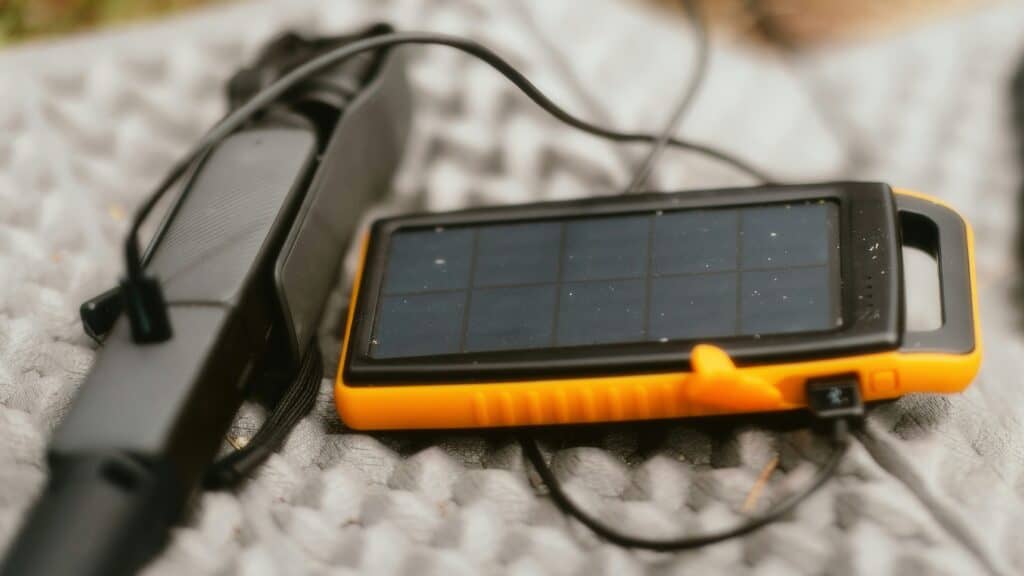
A large battery in a rugged case that happens to have a small panel on it, useful mainly as a battery you charged at home.
Frequently includes a light and sometimes a compass or a hook, which suits the camping use case.
Worth Knowing
The built-in panel is small enough that recharging the bank from it takes days rather than hours.
Treat the solar as backup rather than the point. Our roundup of solar power banks covers the category.
This suits carrying stored charge. Skip it if you expect the panel to do the work.
4. A Clip-On Trickle Panel, Best While Moving
Why It Stands Out
Small and light enough to hang off a pack and generate something while you walk, which is time otherwise producing nothing.
Adds very little weight to a load you are already carrying.
Worth Knowing
Your own body shades it constantly as you move, so real-world output is well below rated.
Better feeding a bank than a phone directly. Our roundup of choosing solar lights covers other pack-mounted gear.
This suits long hiking days. Skip it as your only charging method.
5. A Larger Folding Panel, Best for Groups
Why It Stands Out
Panels in the 40 to 60 watt range charge multiple devices at once or fill a power station rather than a phone.
The right choice when several people are relying on one setup.
Worth Knowing
Considerably bulkier and heavier, which rules it out for anything carried far.
Overkill for a single phone. Our roundup of 200 watt panels covers larger arrays.
This suits car camping and groups. Skip it for backpacking.
6. A Compact Panel Under 15 Watts, Best Value
Why It Stands Out
Cheap and small enough to bring without thinking about it, and adequate for topping up a phone over several hours.
Reasonable insurance for a weekend where the phone is mostly off anyway.
Worth Knowing
Slow. A full charge from empty takes most of a sunny day.
Output claims at this size are frequently optimistic. Our note on solar panel efficiency covers rated versus real output.
This suits occasional use. Skip it if you depend on your phone.
Why Built-In Solar Barely Works
A solar power bank has a panel roughly the size of a phone, and that area determines how much energy it can collect regardless of anything else.
A panel of that size generates only a tiny fraction of what a proper folding panel does, simply because output scales directly with available surface area.
Manufacturers very rarely publish how long that built-in panel actually takes to fill the bank from completely empty, and the honest answer is usually several days of uninterrupted direct sun.
None of that makes the product useless in itself. It just means the solar is a backup feature sitting on a battery you charge from a wall outlet before leaving.
Buying one while expecting the little panel to keep it topped up across a whole trip is precisely where the disappointment tends to come from. Our note on choosing solar panels covers sizing.
Heat Reduces Output
Solar panels lose efficiency as they heat up, which is counterintuitive because the conditions producing the most sun also produce the most heat.
A panel lying directly on a hot surface has nowhere to shed that heat, and the cells run considerably warmer than one with air moving behind it.
Hanging a panel from a pack or a tent guy line rather than laying it on rock or a car roof keeps airflow behind it and recovers some of that loss.
The effect is real and modest rather than dramatic, and it is free to avoid, which makes it worth doing.
It also explains why a panel can produce less at midday in high summer than it does on a cooler bright morning, which people otherwise assume is a fault. Our note on whether panels need direct sunlight covers conditions.
Orientation Matters More Than Rating
Direct sun only, always
Bright shade produces a small fraction of full output.
Angle toward the sun
A panel lying flat loses considerable output most of the day.
Move it as the sun moves
Repositioning twice during a day is worth doing.
Partial shading hurts disproportionately
One shaded cell affects the whole panel.
Phones Do Not Charge From Unstable Input
Charging directly from a panel turns out to be unreliable in changing light, because a single passing cloud interrupts the supply and the phone simply ends the charging session.
Some phones then need the cable reconnecting rather than resuming automatically, which means you can leave one in the sun for hours and return to nothing.
Panels that include a built-in buffer or a smart charging controller handle that situation considerably better by smoothing out the output before it reaches the device.
Charging a power bank instead avoids the problem entirely, since banks accept intermittent input without complaint and pass on steady output.
That is the strongest argument for the panel-plus-bank arrangement over charging a phone directly. Our roundup of accessories covers cables and adapters.
Durability on a Trip
Camping gear takes abuse that bench testing does not cover, and solar chargers have specific weak points worth knowing about.
The junction where the cable enters the panel is the most common failure, since it flexes every time the panel is folded and packed.
Water resistance ratings usually cover the panel face rather than the USB ports, and those ports are frequently the least protected part of the whole assembly.
Grommets tear out of thin fabric edges, which matters if you hang the panel rather than laying it down.
Folding panels also crack at the hinges over enough cycles, and a panel stored folded under weight in a pack takes that abuse continuously rather than only when in use. Our roundup of emergency preparedness gear covers rugged options.
What to Look For
Rated wattage over brand claims
Surface area determines output more than anything else.
USB-C Power Delivery output
Faster charging and works with modern devices.
A way to angle it
Kickstands and grommets both work. Flat on the ground does not.
Honest weight for the use
Backpacking and car camping have very different tolerances.
Common Mistakes to Avoid
Expecting a solar power bank’s panel to recharge it
That panel is the size of a phone and takes days of direct sun.
Laying panels flat
Angling toward the sun recovers meaningful output for no cost.
Charging a phone directly in changing light
Interrupted sessions frequently do not resume on their own.
Buying on rated wattage alone
Real output depends on sun, angle, temperature, and shading.
Recommended Reading
See our note on powering a laptop off grid, our roundup of power stations for camping, our note on running Starlink on solar, and a roundup of solar panel connectors cables.
Solar Phone Charger FAQ
Do solar phone chargers actually work?
Folding panels of 20 watts or more do. The small built-in panels on solar power banks are close to decorative and take days to fill the bank.
Panel or power bank?
Both, ideally. The panel charges the bank during the day and the bank charges devices whenever you want, which decouples generation from use.
What wattage do I need?
Around 20 to 30 watts charges a phone at a useful rate in direct sun. Under 15 works but takes most of a sunny day from empty.
Why did my phone stop charging?
Changing light interrupts the supply and many phones end the session rather than resuming. Charging a power bank instead avoids that entirely.
Does angle matter?
Considerably. A panel lying flat loses meaningful output most of the day, and repositioning it twice as the sun moves is worth the effort.
Can I charge while hiking?
Somewhat. A clip-on panel generates something, though your body shades it constantly and real output falls well below rated.
Are rated wattages accurate?
They describe ideal conditions. Real output depends on sun angle, temperature, and shading, and small cheap panels tend to be the most optimistic.
What about cloudy days?
Output drops sharply. Any solar charging plan for a trip needs a charged battery as the fallback rather than relying on generation.