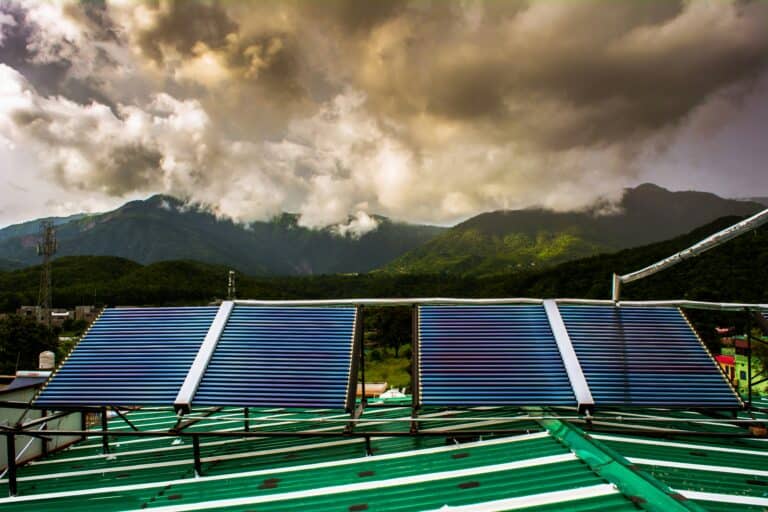
A solar array turns a snowy roof into a slide. Glass is smoother than shingle or metal, so snow that used to melt in place now releases as a sheet, and whatever is below the eave is in the way. Snow guards hold that load where it fell until it melts.
The best snow guards for solar roofs are the ones mounted to the array or the rail rather than screwed into the roof, because adding penetrations to solve a snow problem trades one risk for another. Our roundup of snow removal tools covers the other approach, which is taking the snow off yourself.
This matters most where panels sit above a door, a walkway, a driveway or anything parked. A sheet release from a pitched array arrives all at once.
The Short Version
Clamp-on guards that attach to the panel frame or the rail are the right default, since they add no holes. Use a continuous bar system across a wide array and individual pads on a small one. Check the roof load first, because holding snow on the roof is the entire point and the roof has to take it.
Key Points
- Panel glass is slicker than roofing, so arrays shed snow in sheets rather than gradually.
- Rail and frame-mounted guards avoid new roof penetrations entirely.
- Holding snow up there increases the load the structure carries.
- Guards go at the downslope edge of the array, not at the roof eave.
- Snow on panels also stops production, which guards do not fix.
- Retrofitting is easier than people expect and cheaper than a damaged gutter.
How We Picked
We sorted these by what they attach to, because the choice between clamping to the array and fastening to the roof is the one that carries consequences.
Then we weighted whether a system spreads load across the array or concentrates it at a few points, since concentrated load is how hardware bends.
We have not installed these or measured their load capacity, so nothing here is a result from our own work. Snow loading is a structural question that depends on your roof, your pitch and your climate, and that belongs with someone who can assess the building.
1. A Rail-Mounted Snow Bar System, Best Overall
Why It Stands Out
A continuous bar running across the bottom of the array catches the whole sheet at once and spreads the load into every rail it crosses. Spread load is why this is the approach used on large arrays.
Mounting to existing rails means no new holes and no new flashing, which keeps the roof as it was.
Worth Knowing
The rails have to extend far enough past the panels to take the brackets, and some installs trim rails flush. Measure before ordering.
A bar also holds the snow against the bottom row of panels, which keeps that row covered longer.
This suits most roof arrays with accessible rails. Skip it if the rails are cut flush. Best for: catching a whole sheet and spreading the load.
2. Clamp-On Frame Guards, Best Retrofit
Why It Stands Out
Individual guards clamp directly to the panel frame, which makes them the simplest thing to add to an array that is already up. No rails needed and no roof work beyond getting there.
Because they fit the frame rather than a specific rail family, they work across most arrays.
Worth Knowing
Clamping to a frame puts load into the frame, and panel frames are not structural members. Spacing matters and so does not over-tightening onto the laminate edge.
Check the panel warranty language too, since frame attachments can be restricted. What a solar panel warranty covers goes into that.
This suits retrofits and small arrays. Skip it where loads are heavy. Best for: adding guards to an array already installed.
3. Polycarbonate Pad Guards, Best Low Profile
Why It Stands Out
Clear pads bonded in rows break a sheet into smaller releases rather than holding the whole mass. They are nearly invisible from the ground and add very little weight.
Breaking up the slide rather than stopping it also puts less load into the structure.
Worth Knowing
Adhesive-mounted pads depend on surface prep and on the adhesive surviving freeze-thaw cycling. They are the least durable option here.
They also reduce rather than prevent sliding, so they suit nuisance snow rather than a doorway below a steep array.
This suits appearance-sensitive installs and light snow. Skip it above an entrance. Best for: breaking up small slides discreetly.
4. A Seam-Clamped Snow Fence, Best for Metal Roofs
Why It Stands Out
On standing seam, a fence clamps to the seams the same way the array does, so the whole system stays penetration-free. Metal roofs shed snow aggressively even without panels, which makes this the roof type that needs it most.
A fence below the array also protects the gutter line rather than only the array edge.
Worth Knowing
Clamps are seam-profile specific, exactly as array clamps are, so the same measurement applies. A near fit reduces holding capacity.
Fences also take real load, and that load goes into the seams and then the structure.
This suits standing seam metal roofs with or without solar. Skip it on shingle. Best for: metal roofs, with no new holes.
5. Gutter Guards and Reinforced Hangers, Best Downstream Protection
Why It Stands Out
Gutters are usually the first casualty of a sheet release, and stronger hangers plus a guard cost far less than replacing a torn-off run. It treats the symptom cheaply where the structure cannot take more load.
Guards also stop the gutter filling with the ice that forms after a partial melt.
Worth Knowing
This protects the gutter and nothing else, so anything below the eave is still exposed. It is a complement to guards rather than a substitute.
A gutter full of ice is also a load the fascia was not designed for, whatever hangers you use.
This suits roofs where load limits rule out holding the snow. Skip it as your only measure above a doorway. Best for: protecting the gutter when you cannot hold the snow.
6. Heated Cable and De-Icing Kits, Best for Ice Dams
Why It Stands Out
Where held snow refreezes at the eave, a heated cable keeps a drainage channel open so meltwater leaves instead of backing up under the shingles. Snow guards and ice dams are related problems.
Cables are also cheap relative to the water damage an ice dam causes inside a wall.
Worth Knowing
These consume power through the winter, which is an awkward thing to add to a solar install. They are also a treatment rather than a fix, since ice dams usually trace back to attic heat loss.
Running cable near an array needs care about wiring and clearances. How to winterize a solar system covers the seasonal checks.
This suits roofs with a history of ice damming. Skip it if ventilation is the real problem. Best for: keeping a drainage path open at the eave.
Snow Guards at a Glance
| Option | Mounts To | New Holes | Holding Power |
|---|---|---|---|
| Rail-mounted snow bar | Existing rails | None | Highest |
| Clamp-on frame guards | Panel frames | None | Moderate |
| Polycarbonate pads | Panel or roof surface | None, adhesive | Lowest |
| Seam-clamped snow fence | Standing seam | None | High |
| Gutter guards and hangers | Fascia and gutter | Existing fixings | Protects gutter only |
| Heated de-icing cable | Eave and gutter | Clips | Addresses ice, not sliding |
What to Look For
Attachment that adds no penetrations
Rail and frame mounting keeps the roof as it is, which matters because you are solving a problem the array created. Screwing guards into the roof adds a second set of holes to maintain.
Load spread across the array
A continuous bar crossing several rails distributes the force, while a handful of clamps concentrates it. Concentrated load bends brackets and stresses frames.
What the panel warranty allows
Some manufacturers restrict what may be clamped to a panel frame, and a snow guard is exactly that. Reading the warranty before drilling or clamping is cheaper than discovering it later.
Whether the roof can hold the snow
Guards work by keeping weight on the roof rather than letting it leave, so the structure takes more. In heavy snow country that is a question for someone who can assess the framing.
Holding Snow Against Clearing It
Guards work unattended
They are up there every storm whether you are home or not, which is the argument over any manual approach. They do nothing for production, since the snow stays on the glass.
Clearing restores output and takes effort
Removing snow gets the array generating again, and it also puts you on or near a snowy roof with a tool. Many people in snow country end up doing both, and whether snow damages solar panels covers what the snow itself does.
What Trips People Up
Putting guards at the eave instead of the array
Snow releases off the panel surface, so a guard at the roof edge catches it after it is already moving. The downslope edge of the array is where it needs stopping.
Expecting guards to help production
Holding snow on the array keeps the panels covered for longer, not shorter. Guards are a safety and property measure, and whether solar panels work in winter covers the output side.
Ignoring the extra load
Snow that would have slid off is now snow the roof is carrying, on top of the array itself. How much weight solar panels add and the roof load calculator both bear on it.
Adding holes to fix a sliding problem
Roof-screwed guards introduce the leak risk the array install worked to avoid. Whether solar panels cause roof leaks covers why that trade is a poor one.
Deciding Whether You Need Them
Look at what is below the array
A door, a path, a driveway, a deck or a parking space turns a sliding sheet from a nuisance into a hazard. An array over a back garden with nothing beneath it is a different calculation.
Pitch and panel position matter
Steeper arrays release sooner and faster, and panels mounted near the eave give snow a short run before it leaves the roof entirely.
Mounting hardware comes first
What you can clamp to depends on what the array was built with, so the rail and mount decision shapes the options. Mounting kits cover that groundwork.
Cleaning access is related
Anything bolted across the bottom of the array is also in the way when you want to reach the glass. How often you should clean panels covers how much that costs you.
Recommended Reading
Worth reading next: solar panel cleaning brushes, which cover reaching the glass once the snow is gone.
Snow Guard FAQ
What are the best snow guards for solar roofs
A rail-mounted snow bar is the strongest option and adds no holes, with clamp-on frame guards as the easy retrofit. On standing seam metal a seam-clamped snow fence does the job, and polycarbonate pads suit light snow where appearance matters.
Do solar panels make snow slide off a roof
Yes, because panel glass is smoother than shingle or tile, so snow releases as a sheet instead of melting in place. That is the whole reason snow guards come up on solar roofs that never needed them before.
Where do snow guards go on a solar array
At the downslope edge of the array, since that is where the sheet leaves the glass. Guards at the roof eave catch snow that is already in motion, which is far less effective.
Will snow guards reduce my output
They keep snow on the panels longer, so yes, output stays down for longer after a storm. If production through winter is the priority, clearing the array is the approach rather than holding the snow.
Can I add them to an existing array
Usually, and clamp-on frame guards exist for exactly that. The limiting factor is whether the rails extend past the panels far enough for bracket-mounted systems.
Do they add load to the roof
Yes, and that is how they work. Snow that would have slid off stays up there, so in heavy snow regions the structural capacity is worth checking before adding them.
Will clamping to the panel frame void the warranty
It can, since some manufacturers restrict what may be attached to the frame. Check the warranty document for your specific panels before clamping anything to them.
Are heated cables an alternative
They address a different problem, which is meltwater refreezing at the eave rather than snow sliding off the array. They also draw power all winter, so they suit roofs with a real ice dam history rather than general use.