
The panel itself usually transfers to a boat without trouble, while the mounting hardware, connectors and wiring are the parts that fail in a salt environment and generally need marine grade replacements. So when someone asks can you use RV solar panels on a boat, the answer is yes for the glass and cells, and no for most of the metal bolted around them.
The laminate is doing physics that salt air cannot interrupt. Everything else is doing a mechanical or electrical job in conditions it was never built for, and it helps to judge the two separately. That split also lines up with the general questions in our guide to picking a panel that suits the install.
Quick Answer
A rigid RV panel will produce power on a boat, because the laminate does not care about salt. The frame, brackets, fasteners, connectors and cable terminals do care, and those corrode first. Plan on marine grade hardware and a completely different mounting approach.
A Quick Note
This is general guidance, not a wiring plan for any particular vessel. DC wiring carries real risk, and work on a roof, arch or mast carries its own. Have a qualified marine electrician or installer sign off on anything here you are unsure about.
| Component | Transfers to a boat? | What to watch |
|---|---|---|
| Panel laminate and cells | Yes, generally fine | Sealed glass and encapsulant shrug off salt spray. Check the edge seal for cracks. |
| Aluminum frame | Usually, with care | Anodized aluminum holds up reasonably well. Pitting starts where the coating is scratched. |
| Junction box and connectors | Often not | Weather rated is not spray zone rated. Salt creep raises contact resistance. |
| Mounting brackets and feet | Rarely | RV feet assume a flat, fixed roof. Boats need rail clamps, arch fittings or bimini frames. |
| Fasteners and screws | No, replace them | Plated steel bleeds rust streaks. Use stainless of a suitable marine grade throughout. |
| Wiring and terminals | No, replace them | Marine practice favors tinned copper with crimped, sealed terminals. Untinned strands wick moisture. |
| Charge controller | Sometimes, if relocated | The electronics work the same in a dry, ventilated spot. Reprogram it for the new bank. |
| Fuses, breakers and grounding hardware | No, specify fresh | Protection sizing follows boat wiring standards. Bonding hardware belongs with a marine electrician. |
What carries over from a recreational vehicle install to a boat, component by component.
What Actually Differs About a Marine Environment?
Three things change once a panel goes afloat: salt, constant motion, and a surface that is never quite level. Each attacks a different part of the install. None of them touch the cells.
Airborne salt settles everywhere, then pulls moisture from the air and stays damp long after rain would dry. That damp film is an electrolyte, and an electrolyte turns two dissimilar metals into a slow battery.
Motion is the quieter problem. Fixings that sit undisturbed for a decade on a roof work loose over a season of rolling. Heel and swell also shift the panel angle constantly, so a fixed panel lives with a moving average.
Why Does the Panel Survive but the Frame Not?
A panel is a stack of cells sealed between glass and a polymer backsheet, already built to keep water out for decades. Salt does not chemically attack cured glass or the encapsulant. That makes the laminate the one component most worth moving.
The frame is different. Aluminum survives behind a thin oxide skin, and anodizing thickens that skin deliberately. Scratch it or drill it, and fresh metal sits exposed.
Fasteners are worse again. Plated screws lose their coating at the threads during installation, and a rust streak follows. Junction boxes usually hold, but the cable gland and connector tails deserve a close look.
What Is Galvanic Corrosion, in Plain Language?
Galvanic corrosion happens when two different metals touch while a conductive liquid bridges them. The less noble metal gives up material to the other. The further apart the two metals sit on the galvanic scale, the faster it runs.
On a dry roof that bridge evaporates. Afloat, the salt film keeps it damp almost permanently, so a mismatched bracket and bolt can chalk and weaken in a season. Aluminum against stainless is the pairing to watch.
Isolation is the usual fix. Nylon washers, a barrier sealant, and matched metals within each joint all cut the effect down. Getting this right at install time beats diagnosing a soft bracket later.
Do Connectors and Terminals Need Replacing?
Assume yes. Once salt creeps into a connector contact, resistance climbs, and higher resistance means heat exactly where you least want it.
Marine practice leans on tinned copper conductors, crimped terminals and heat shrink with a sealant lining. Crimped and sealed beats soldered here, because a soldered joint stiffens and cracks under vibration.
Routing matters as much as terminations. Protect cable where it can chafe, and leave drip loops so water runs away from a connector.
Are Flexible Panels a Better Fit Than a Rigid RV Panel?
For curved surfaces, yes. Flexible and semi flexible panels bond or lace onto cabin tops and bimini fabric where a framed panel cannot sit flat. A rigid panel forced onto a curve loads the laminate and eventually cracks cells.
The trade is heat and durability. Flexible panels sit close to the surface, so they run hotter, and cell output falls as temperature rises. Our explainer on how panel efficiency is measured covers that relationship.
Walk-on rated semi flexible panels exist for deck use. A framed RV panel is not walk-on rated, so whether panels take foot traffic matters far more on a side deck than on a rig roof.
Where Does a Panel Mount, and What Shades It?
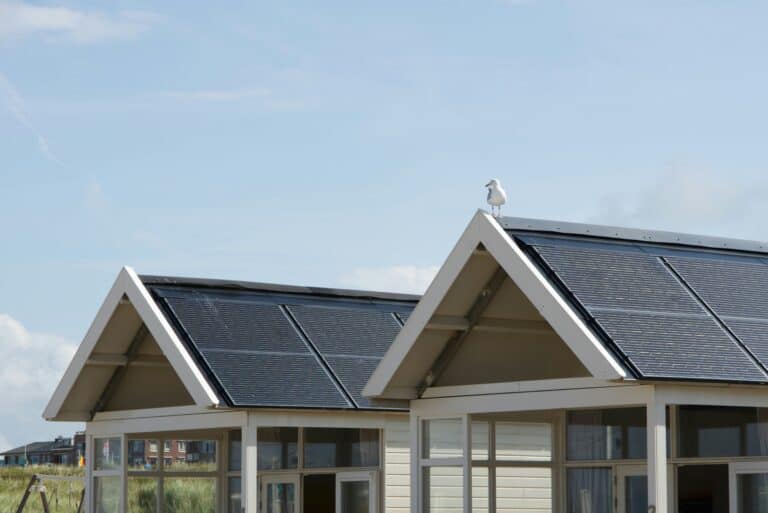
Boats mount panels on stern rails, davits, purpose-built arches and bimini tops rather than a flat roof. Rail mounts and arch fittings suit rigid panels and hold them clear of the deck, which also helps them run cooler.
Shading is the factor most people underestimate. A mast, boom, backstay and running rigging sweep shadows across the deck as the boat swings. An RV roof has a vent to work around, which is far simpler.
Shading is not proportional either. A thin shadow across one string of cells can pull down the whole panel, depending on the bypass diode layout. Two smaller panels wired separately often do better.
Motion adds a maintenance job that roofs do not. Check clamps, fixings and cable supports each season, since vibration loosens things quietly.
Is Reusing RV Panels Cheaper Than Starting With Marine Gear?
It depends on what you already own and what you would buy twice. A spare panel in good condition, on a boat with a rail or arch that fits it, is genuinely economical. The laminate is the expensive part, and it is the part that transfers.
The sums change as the shopping list grows. New mounts, stainless fasteners, tinned cable, sealed terminations and a relocated controller can add up past the cost of hardware built for the job. At that point, starting fresh from our roundup of panels built for boats and marine use is the calmer path.
What This Answer Cannot Settle for You
Some of this depends on the specific vessel and hardware. Boat wiring standards are their own discipline, with rules on conductor type, overcurrent protection and disconnect placement. Vehicle practice overlaps but does not substitute.
Bonding and grounding is the clearest example. Bonding decisions interact with underwater metals, anodes and stray current, so a well-meaning ground connection can create corrosion below the waterline. Even the background on whether panels need grounding stops short of marine bonding.
Insurance and survey requirements can decide the question outright. A surveyor or insurer may expect installed equipment to meet recognized marine standards, whatever an improvised install achieves. Ask before buying rather than after.
One limit holds whatever the hardware. A rigid framed panel on a curved cabin top or bimini will not sit properly, and no bracket fixes that.
What Trips People Up
Assuming weatherproof means saltproof
Outdoor ratings cover rain, dust and sun, not a permanently damp salt film. Connectors and glands that last years on a roof can degrade in a season near spray.
Reusing the original brackets
RV feet suit a flat, fixed roof, not a rail, arch or curved cabin top. Adapting them usually creates a stress point and a leak path.
Ignoring shading from rigging
A spot chosen on a sunny afternoon can sit under a boom shadow half the day. Watch the shadow pattern across a full day before drilling.
Carrying over the old charge settings
Charge profiles follow the battery chemistry on board, and a boat bank is often a different chemistry. Reprogramming the controller to match is not optional.
Related Reading
For a sense of how these framed panels are specified, our roundup of panels aimed at recreational vehicle roofs is the natural companion to this one. If the goal is usable power away from shore power rather than a permanent install, the comparison of portable power stations for camping trips covers a lower commitment route that suits small boats too. Either way, our notes on what panel upkeep involves apply doubly once salt is in the picture.
Frequently Asked Questions
Can you use RV solar panels on a boat without replacing anything?
Rarely, and only in sheltered fresh water. The laminate itself is fine, but the mounting hardware, fasteners, connectors and cable terminations are the weak points in salt air. On any boat that sees spray, swap the hardware and terminations for marine grade parts.
Will salt water damage the solar cells themselves?
Not directly, because the cells sit sealed between glass and a backsheet that salt does not chemically attack. Damage tends to start at edges, drilled holes and the junction box, where that seal has been interrupted. Inspect those areas closely on any reused panel.
Are marine solar panels physically different from RV panels?
Often, yes. Marine oriented panels lean toward flexible construction for curved surfaces, walk-on ratings for decks, and hardware chosen for salt exposure. Rigid framed panels also exist for arches and rails, so the real differences sit in mounting, cabling and corrosion resistance rather than the cells.
Do flexible panels always beat rigid panels on a boat?
No, it depends on the surface. Flexible panels win on curved cabin tops and bimini fabric, where a rigid panel cannot lie flat. Rigid panels on an arch or rail sit clear of the deck and run cooler, so choose by mounting surface first.
How much does rigging shade reduce output?
Enough to matter, and more than the shadow size suggests. Cells in a string share current, so a narrow shadow can pull down a whole section of the panel. Splitting the array into two smaller panels on separate controller inputs reduces the effect.
Can the same charge controller move across from an RV install?
Usually the unit itself can, provided it suits the new battery bank. Reprogram it for the boat battery chemistry and capacity instead of carrying old settings across. Mount it somewhere dry and ventilated, and size overcurrent protection for the new wiring run.
When is this a job for a marine electrician rather than a weekend project?
Any time bonding, grounding, through-hull fittings or the existing DC distribution are involved. Marine bonding interacts with underwater metals and anodes, and mistakes there show up as corrosion below the waterline. A qualified marine electrician should also review overcurrent protection and disconnect placement against boat wiring standards.