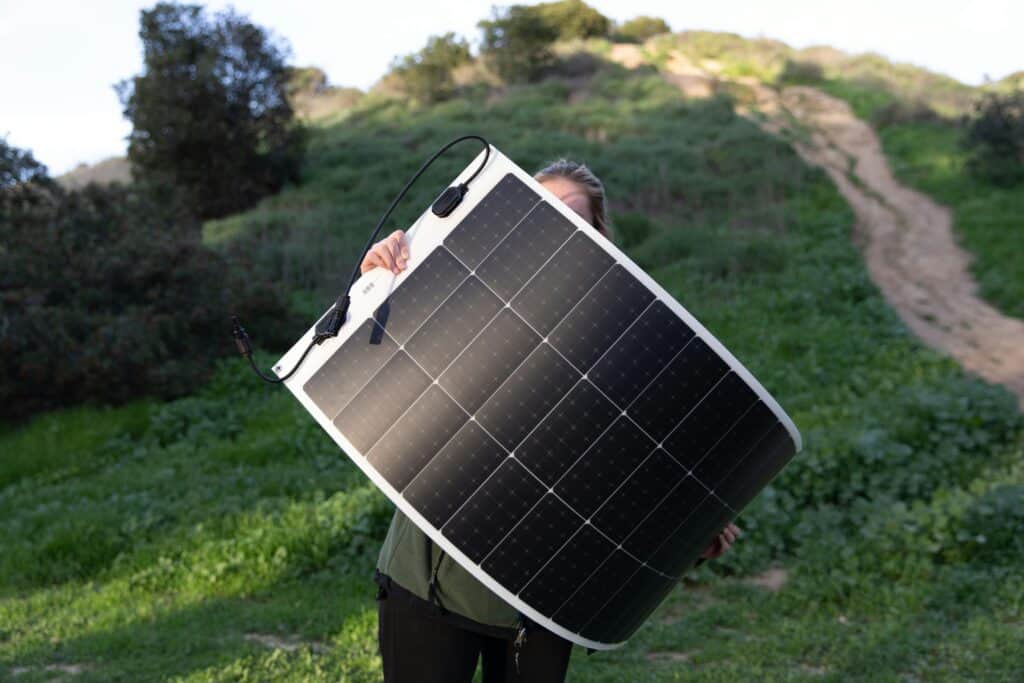
Got a van roof that curves, a sailboat deck, or a rounded camper lid where a rigid panel simply will not sit flat? The best flexible solar panels conform to those surfaces, mount with little or no drilling, and add a fraction of the weight of glass-and-aluminum panels. The right one balances real efficiency, a durable ETFE surface, and a brand that will still honor the warranty in a few years.
Quick verdict:
- Best overall: BougeRV Arch Pro 200W, with efficient N-Type cells and fiberglass backing.
- Best trusted brand: Renogy 200W Flexible, proven output and warranty support.
- Best for tight curves: BougeRV Yuma 200W CIGS, a rollable thin-film panel.
- Best budget: Topsolar 100W Flexible, reliable basics at a low price.
How We Picked the Best Flexible Solar Panels
We focused on what matters for curved-surface installs: efficiency and real-world output, bend radius, ETFE surface durability, weight, and the strength of each brand’s warranty and support. We weighed how heat affects flexible panels, since they run hotter without an air gap, a factor the research on photovoltaic performance from the National Renewable Energy Laboratory helps explain. The notes below come from published specifications and consistent owner reports, since the focus here is research rather than hands-on testing of every panel.
| Your situation | BougeRV Arch | Renogy 200W | Renogy 100W | BougeRV Yuma | Topsolar 100W |
|---|---|---|---|---|---|
| Gently curved van roof | Best fit | Best fit | Workable | Workable | Workable |
| Extreme or rolling curve | Skip | Skip | Workable | Best fit | Skip |
| Trusted brand and warranty | Best fit | Best fit | Best fit | Workable | Skip |
| Tight budget | Skip | Skip | Workable | Skip | Best fit |
| Compact, low-wattage build | Skip | Skip | Best fit | Workable | Best fit |
Solar panel prices shift with sales, tariffs, and stock, so confirm the current cost before you buy.
1. BougeRV Arch Pro 200W: Best Overall
Why It Stands Out
The BougeRV Arch Pro 200W leads the flexible category with newer N-Type cells and a fiberglass-backed build. Its efficiency rivals many rigid panels, so you give up little power for the flexibility. The reinforced construction feels a step above older flexible designs.
Worth Knowing
It suits gently curved roofs on vans like Sprinters, Transits, and ProMasters. Like all flexible panels, it runs hotter without an air gap, so output dips on hot, dark roofs. BougeRV backs it with a solid warranty and remote-monitoring options.
It suits the builder who wants near-rigid performance in a low-profile, curved-roof package. Skip it if your roof is flat with room for cheaper rigid panels. For most flexible installs, it is the easiest panel here to recommend. The newer cell technology is what closes the gap with rigid panels.
The fiberglass backing is a meaningful durability upgrade over thin-film alternatives.
2. Renogy 200W Flexible: Best Trusted Brand
Why It Stands Out
The Renogy 200W Flexible is the flagship from a brand built on RV solar. Its PERC cell technology helps it perform better in cloudy and partial-shade conditions than older flexible panels. A long power-output warranty gives peace of mind that budget panels cannot match.
Worth Knowing
Owners report it holding most of its rated output season after season over years of use. The higher open-circuit voltage means you should check charge-controller compatibility. It costs more per watt than budget options, but the support is part of what you pay for.
It suits the RVer already in the Renogy ecosystem or wanting a brand they can call. Skip it if your budget is tight or you need extreme flex. For a well-supported flexible panel, it is a top choice. Years of RV-specific experience back the brand behind it.
The long output warranty is reassuring on a panel that lives in harsh sun.
3. Renogy 100W Flexible: Best for Tight Curves
Why It Stands Out
The Renogy 100W Flexible bends to a generous radius, wrapping more curved surfaces than many panels. Its sleek, lightweight build suits compact installs and tighter roof contours. It carries the same Renogy reliability and support as the larger model.
Worth Knowing
The lower wattage suits modest needs or phased builds rather than heavy loads. ETFE lamination handles UV exposure better than cheaper coatings. Pairing two of these can fit awkward roof shapes better than one large panel.
It suits the builder with a curved roof and modest power needs or limited space. Skip it if you need maximum wattage in a single panel. For tight curves and small builds, it is a flexible, trusted pick. Two smaller panels often fit a tricky roof better than one large slab.
Its wide bend range makes it forgiving on irregular roof contours.
4. BougeRV Yuma 200W CIGS: Best for Extreme Curves
Why It Stands Out
The BougeRV Yuma 200W uses CIGS thin-film technology instead of traditional silicon. That makes it the most flexible panel available, wrapping around very tight radii and even rolling up. For Airstreams and extremely curved roofs, it goes where rigid silicon cannot.
Worth Knowing
Its efficiency is lower than silicon panels, so it needs more area for the same wattage. The extreme flexibility is the whole point, suiting compound curves and roll-up storage. It is favored in forums for unusual mounting challenges.
It suits the builder with a severely curved roof or a need to roll the panel away. Skip it if you have a flatter surface where efficient silicon fits. For extreme flexibility, nothing else here matches it. Thin-film technology is the reason it bends where silicon would crack.
The rollable design opens up installs that defeat every rigid panel.
5. Topsolar 100W Flexible: Best Budget
Why It Stands Out
The Topsolar 100W Flexible delivers solid basics at an approachable price. Its monocrystalline cells reach respectable efficiency, and an ETFE coating handles UV better than cheaper PET surfaces. Pre-drilled holes and MC4 connectors speed up setup.
Worth Knowing
It is not the lightest, most efficient, or most durable option, but it works reliably for simple 12V systems. Support exists but can be slow, which is the budget trade-off. It suits camper vans and boats running basic loads.
It suits the builder who wants dependable flexible output without premium pricing. Skip it if you want top efficiency or the strongest warranty. For a simple, affordable flexible panel, it does the job. The ETFE surface is a meaningful step up from the cheapest PET-coated panels.
It is a sensible entry point for testing solar before investing more.
6. ALLPOWERS SF200: Best Value 200W
Why It Stands Out
The ALLPOWERS SF200 offers 200 watts of flexible output in a more affordable package. It is a practical pick when you want higher wattage without a premium price. The lightweight build suits weight-sensitive van and boat installs.
Worth Knowing
It connects at 12V to integrate with standard battery banks. As with most budget flexible panels, factor in heat-related output loss on dark roofs. The warranty and track record are not at the level of Renogy or BougeRV.
It suits the builder who wants 200W of flexibility at a friendlier price. Skip it if longevity and warranty depth are your priority. For value at higher wattage, it is a reasonable pick. Just weigh the lower warranty depth against the upfront savings.
The price per watt is the main draw for larger flexible arrays.
How to Choose Flexible Solar Panels
A few decisions shape whether a flexible panel fits your build. Work through these before buying.
Bend Radius and Roof Shape
Match the panel’s bend radius to how sharply your roof curves. Most flexible panels handle gentle curves, while CIGS thin-film wraps the tightest radii. Measure your roof contour before choosing.
Efficiency and Cell Type
N-Type and PERC silicon panels deliver the highest efficiency, while CIGS trades efficiency for extreme flex. Higher efficiency means more watts per square foot, which matters on limited roof space. Choose the cell type that fits your space and flex needs.
Durability and ETFE Surface
An ETFE surface resists UV and weather far better than cheaper PET coatings. Reinforced edges and fiberglass backing improve longevity against vibration. Surface quality is a major factor in how long a flexible panel lasts.
Brand and Warranty
The flexible market is full of brands that appear and vanish, so a track record matters. Established brands like Renogy and BougeRV are more likely to honor warranties. Search owner reports for your specific model before buying.
Mounting Flexible Panels the Right Way
How you attach a flexible panel affects both its output and its lifespan. A few approaches work better than others.
Adhesive and VHB Tape
Strong VHB tape or panel-specific adhesive gives a clean, no-drill bond to a roof. It suits builders avoiding roof penetrations on a van or trailer. Surface prep and the right adhesive are key to a lasting hold.
Brackets and Edge Mounts
Edge brackets or grommets let air move beneath the panel, which helps it run cooler. This raises output compared to gluing the panel flat. It is the better choice where you can accept a slightly higher profile.
Leaving an Air Gap
Any method that creates airflow under the panel reduces heat-related output loss. Thin spacers or a corrugated underlayment can help. The cooler the panel runs, the closer it gets to its rated output.
Flexible vs Rigid Solar Panels
The core decision is whether flexible is right for your install at all. Here is the trade-off.
When Flexible Wins
Flexible panels fit curved roofs, weigh far less, and allow no-drill, low-profile mounting. They suit vans, boats, and weight-sensitive builds where rigid panels cannot mount. The convenience and shape-fit are the main draws.
When Rigid Wins
Rigid panels last longer, run cooler on tilted mounts, and cost less per watt. For flat roofs with space, they are the more durable, economical choice. Our guide to the best RV solar panels covers rigid options.
Common Flexible Solar Panel Mistakes to Avoid
A few errors shorten the life or cut the output of a flexible panel. Each is easy to avoid.
Gluing Panels Flat With No Airflow
Mounting a flexible panel flat against a dark roof traps heat and reduces output. Leave an air gap or mounting channel where possible to help it run cooler. Heat management is the biggest factor in flexible-panel performance.
Choosing Cheap Over Durable
The lowest-priced flexible panels often use weaker coatings and vanish-brand warranties. Spend on ETFE surfaces and established brands for a longer service life. A panel that fails in two years costs more than a durable one.
Mismatching the Charge Controller
Flexible panels can have higher voltages that some controllers cannot handle. Check the open-circuit voltage against your controller’s limits. An MPPT controller helps recover output lost to heat.
Walking on the Panels
Flexible does not mean indestructible, and stepping on cells can crack them. Keep foot traffic off mounted panels. Treat the surface as delicate despite its bendable design.
Frequently Asked Questions
What are the best flexible solar panels in 2026?
The BougeRV Arch Pro 200W is the best overall pick, with efficient N-Type cells and durable fiberglass backing. For a trusted brand with strong warranty support, the Renogy 200W Flexible leads. For extreme curves, the rollable BougeRV Yuma CIGS panel stands alone.
Are flexible solar panels as good as rigid?
Flexible panels have narrowed the efficiency gap but still run hotter and generally last fewer years than rigid panels. They win on weight, low-profile mounting, and fitting curved roofs. For flat roofs with space, rigid panels remain more durable and cheaper per watt.
How long do flexible solar panels last?
Flexible panels typically last fewer years than rigid ones, with quality ETFE models from established brands faring best. Heat buildup from flat mounting is the main factor that shortens their life. Good airflow and a durable surface extend service life.
Can I walk on a flexible solar panel?
No, stepping on a flexible panel can crack the cells even though the panel bends. Keep foot traffic off mounted panels. Treat the surface as delicate despite the bendable design.
Do flexible panels work on a curved van roof?
Yes, fitting curved roofs is exactly what flexible panels are for, with most handling gentle curves and CIGS thin-film wrapping tight radii. Match the panel’s bend radius to your roof contour. Leave airflow where possible to manage heat.
Why do flexible panels produce less in summer?
Flexible panels mounted flat against a roof lack the air gap that rigid tilted panels have, so they run hotter, and heat reduces output. Expect a noticeable drop on hot, dark roofs. Adding airflow beneath the panel helps recover some output.
What charge controller do I need for flexible panels?
Match the controller to your panel’s voltage, and an MPPT controller is best for recovering output lost to heat. Check the panel’s open-circuit voltage against the controller’s limits. Higher-voltage flexible panels need careful controller selection.
Where can I learn more about solar panel efficiency?
The National Renewable Energy Laboratory and the U.S. Department of Energy’s Solar Energy Technologies Office publish research on photovoltaic efficiency and performance.
Recommended read: Build out your system with our guides to the best RV solar panels, best solar charge controllers, and best 12V batteries for solar. For complete packages, see the best solar panel kits.
Recommended Reading
- Best 100 Watt Solar Panels
- Best Foldable Solar Panels Camping
- How Solar Panels Charge Batteries
- a larger 200-watt panel
- choosing solar panels
Related: solar panels for apartment balconies.
Curved surfaces and salt air change the requirements. Marine solar and what survives it covers boat installations.