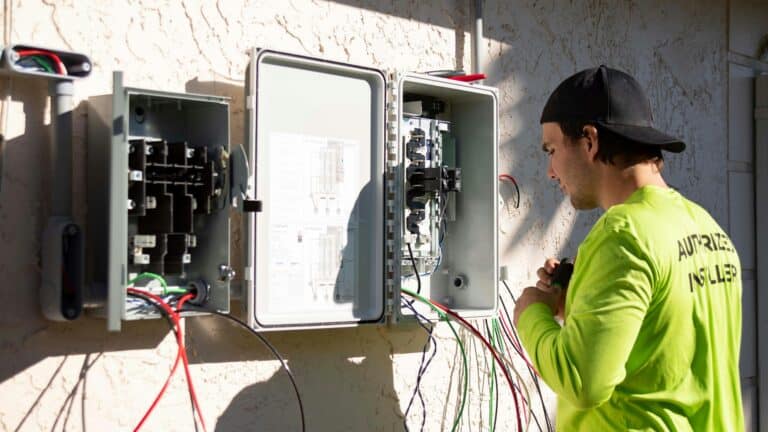

Your meter measures electricity flowing both directions, and you get bill credit for what you export instead of payment for it. How net metering works is a state-by-state question rather than a national one, because what a credit is worth depends entirely on the rules your utility operates under.
Several states have already moved off full retail credit. Our guide to how long solar takes to pay off covers why that single variable moves the whole calculation.
A Quick Note
This is general information, not financial or legal advice. Net metering rules are set by state legislatures and utility commissions, they differ between utilities within one state, and they change. Confirm the current terms with your own utility and state commission before making a purchase decision, and get the tariff name in writing.
Quick Answer
Excess generation flows to the grid and earns a bill credit. Under traditional net metering that credit is at the retail rate, so a kilowatt-hour exported offsets a kilowatt-hour imported. Newer tariffs credit exports at a lower value-based rate instead. Thirty-eight states, Washington DC and four territories offer net metering, with substantial differences between them.
Key Takeaways
- Export credit, not a cash payment, is the usual mechanism.
- Retail-rate credit is the traditional and most favorable version.
- Value-based export rates pay considerably less than retail.
- Rules differ by state and by utility within a state.
- Several states have replaced net metering outright.
- Existing customers are usually grandfathered for a set term.
- Get your tariff name and its end date in writing.
| Compensation model | What an exported kilowatt-hour earns | Effect on payback |
|---|---|---|
| Full retail net metering | Credit equal to the retail rate | Most favorable |
| Net billing or value-based export | A grid-value rate, usually below retail | Longer payback, favors batteries |
| Avoided cost or wholesale credit | What the utility would have paid a generator | Well below retail |
| Value of solar tariff | A calculated value set by the regulator | Depends on the calculation |
| Buy all, sell all | All output sold, all consumption bought | Separates the two entirely |
| No export compensation | Nothing for exports | Self-consumption only |
The Mechanism in Plain Terms
Your panels supply your house first. Whatever the house is not using at that moment leaves through the meter.
At night and on cloudy days the flow reverses and you draw from the grid as normal. A bidirectional meter records both directions separately.
At the end of the billing period the utility nets the two against each other, which is where the name comes from.
Nothing about that changes between states. What changes is the exchange rate applied to the export side. Our guide to reading a solar monitor covers watching those flows in real time.
Retail Credit Versus Value-Based Credit
What retail credit means
An exported kilowatt-hour cancels an imported one. The California Public Utilities Commission describes traditional net energy metering credits as applied to customers’ monthly bills at the retail rates.
What replaced it there
Under California’s net billing tariff, the CPUC describes export compensation as applied at a rate reflecting the value of that generation to the grid, which is usually lower than the retail rate, drawn from its Avoided Cost Calculator values.
Why the difference is large
Retail rates include generation, transmission, distribution and program costs. A grid-value rate reflects only what the energy is worth to the system at that hour.
What it changes for you
Exporting becomes worth much less than self-consuming. Our guide to adding batteries to existing solar covers the response that follows from that.
How Much It Varies by State
The National Conference of State Legislatures reports that thirty-eight states, Washington DC and four territories offer net metering, with utilities in Idaho and Texas having voluntarily adopted programs of their own.
Seven states use compensation rules other than net metering, and Minnesota offers both conventional net metering and a value of solar approach alongside it.
NCSL also notes that at least five states have implemented alternative compensation methods in place of net metering, naming Arizona, Hawaii, Indiana, Maine and Nevada.
Within the states that do have it, NCSL describes differing approaches across capacity limits, eligible technology, credit retention and renewable energy credit ownership. Our guide to Arizona net metering and solar incentives covers one of those alternative-compensation states in detail.
The Arguments Behind the Reforms
The case against retail credit is that it compensates a household for energy at a price that includes the cost of poles, wires and programs the household still uses. NCSL summarizes critics as arguing exports should be credited at avoided cost or wholesale rather than retail.
The case for retail credit is that distributed generation delivers energy at the point of use, avoids line losses, and reduces peak demand.
Regulators have landed in different places on that, which is the whole reason the map looks the way it does.
Buy all sell all and value of solar tariffs are the two main alternative structures NCSL describes. Our guide to questions to ask a solar installer covers getting the local answer rather than a general one.
Grandfathering Is the Detail That Matters Most
- Ask which tariff you will be on. By name, not by description, since the names carry legal meaning.
- Ask how long it is guaranteed. Terms are finite and they differ sharply between programs.
- Ask what happens at the end of it. You move to whatever the prevailing tariff is then.
- Ask whether the date is application or interconnection. Those can fall in different program years.
- Ask if it transfers with the house. This affects resale, not just your own bills.
- Get all of it in writing. A verbal answer from a salesperson is not a tariff.
California illustrates how much these terms differ. The CPUC states that net metering tariffs there closed to new enrollments and that customers applying for interconnection since April 2023 take service on the net billing tariff instead, that earlier customers retain their tariff for twenty years from interconnection, and that a net billing customer is guaranteed that tariff for nine years.
Our guide to what permits you need for solar covers the interconnection application that starts that clock.
What Net Metering Does Not Do
It does not keep your lights on in a blackout. A grid-tied inverter without battery backup shuts down when the grid goes down, for the safety of line workers.
It does not usually pay cash. Most programs issue bill credits, and many cap or expire an accumulated surplus rather than cutting a check.
It does not remove fixed charges. Meter, service and program charges generally continue regardless of what you generate.
It also does not make an oversized array free money. Our guide to anti-islanding on grid-tied solar covers the blackout behavior, and our guide to what happens if you oversize your solar array covers why building past your own consumption rarely pays under a value-based tariff.
How It Changes the System You Should Build
Under full retail credit, the grid behaves like a free battery and sizing to annual consumption makes sense. Timing barely matters.
Under a value-based export rate, timing becomes the whole game. Energy used at home is worth the retail rate you avoid paying, while energy exported is worth the lower credit.
That shifts value toward storage, load shifting and west-facing panels that generate later in the day.
The right system under one tariff is the wrong system under the other. Our guide to what a hybrid solar system is covers the architecture that handles both, and our guide to running solar panels without a battery covers the simpler alternative.
Related Reading
- How the federal solar tax credit works
- Do solar panels increase home value
- Solar monitoring and production meters
Frequently Asked Questions
How does net metering work?
A bidirectional meter records electricity flowing to and from the grid separately, and the utility nets them against each other at the end of the billing period. Exported energy earns a bill credit. What that credit is worth depends on your state and utility.
Do you get paid cash for exported solar power?
Usually not. Most programs issue bill credits rather than payments, and many cap or expire an accumulated surplus instead of sending a check. Buy all sell all structures are the exception, since they sell all output and buy all consumption separately.
How many states have net metering?
NCSL reports thirty-eight states, Washington DC and four territories offer it, with utilities in Idaho and Texas voluntarily adopting programs. Seven states use other compensation rules, and at least five have replaced net metering with alternatives, including Arizona, Hawaii, Indiana, Maine and Nevada.
What is the difference between retail credit and value-based credit?
Retail credit means an exported kilowatt-hour cancels an imported one. A value-based rate credits exports at what the energy is worth to the grid at that hour, which the CPUC describes as usually lower than the retail rate. The gap can be large.
Will my net metering terms change later?
Possibly. Programs are usually guaranteed for a fixed term and then you move to whatever tariff prevails at that point. California, for example, guarantees earlier net metering customers twenty years from interconnection and net billing customers nine years.
Does net metering keep the power on during an outage?
No. A grid-tied inverter without battery backup shuts down when the grid goes down, which protects line workers. Backup power requires a battery and the right inverter architecture, and that is a separate purchase from net metering.
Should you oversize your array to bank more credits?
Under full retail credit that can make sense up to your annual consumption. Under a value-based export rate it usually does not, since exported energy earns much less than energy you use yourself, and surplus credits are often capped or expire.
What should you ask before signing?
The tariff name, how long it is guaranteed, whether the clock starts at application or interconnection, what happens when the term ends, and whether it transfers to a buyer if you sell. Get every answer in writing.
Sources
- California Public Utilities Commission, net energy metering and net billing
- National Conference of State Legislatures, state net metering policies