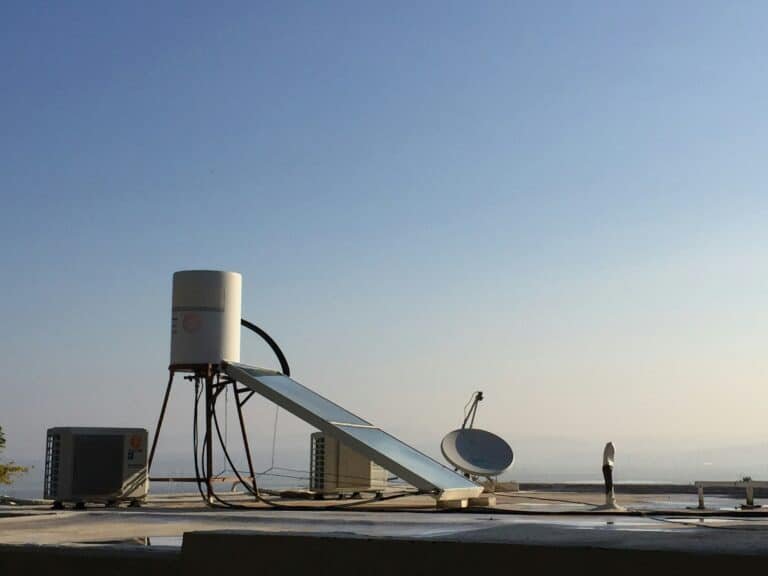

Can a solar well pump run at night is usually asked as a battery question, and the standard answer is not a battery at all. It is a tank. You pump water during the day into storage and draw from that storage after dark, which means the pump itself never has to run at night.
That design is the reason solar well pumping works as well as it does off grid. Water is the storage medium, and it is far cheaper to store than electricity.
Our guide to running solar panels without a battery covers the direct drive principle behind it.
Quick Answer
A direct drive solar pump runs only in daylight, so you size a storage tank to cover nights and cloudy days and feed the house from the tank. Batteries let the pump itself run after dark, which is occasionally necessary and usually the more expensive route.
Key Takeaways
- Store water, not electricity, wherever you can.
- A direct drive pump runs only while the sun is on the array.
- Tank capacity is what covers nights and poor weather.
- Gravity or a small pressure pump delivers from the tank.
- Batteries suit cases where storage is impractical.
- A controller smooths output so the pump starts earlier.
- Freezing is the main constraint on outdoor storage.
| Approach | Runs at night? | Trade-off |
|---|---|---|
| Direct drive plus storage tank | Pump no, supply yes | Needs space and tank cost |
| Direct drive plus pressure tank only | Briefly | Very limited reserve |
| Battery backed pump | Yes | Battery cost and replacement |
| Hybrid, solar with grid or generator | Yes | Fuel or connection needed |
| Gravity feed from elevated tank | Yes, no power | Needs elevation |
| Tank plus small pressure pump | Yes | Small battery for the booster |
Why Storage Beats Batteries Here
Water is cheap to hold
A tank has no cycle life, no chemistry and no replacement schedule. It holds its contents indefinitely and costs nothing to keep full.
Batteries are a consumable
A battery bank degrades whether you use it or not, and replacing it is a recurring cost across the life of the system. Our guide to why solar batteries degrade covers that decline.
The pump wants full power
A submersible pump draws hard on start and runs best near its design voltage. Feeding it from a bank adds conversion losses and a sizing problem.
Oversizing the array is cheaper
Extra panels extend the pumping window into the shoulders of the day. That is usually a better spend than battery capacity for the same gain.
Can a Solar Well Pump Run at Night From a Battery Bank?
Yes, and sometimes that is the right design. The pump runs from the bank, the array recharges it, and timing stops mattering.
The cases that justify it are specific. No room for a tank, a site where freezing makes outdoor storage impractical, or a demand pattern that needs pressure at odd hours without a booster.
Livestock watering is another. A trough that must refill overnight on a schedule can suit a battery better than a large tank on a hill.
Our roundup of solar livestock watering systems covers those arrangements.
Sizing the Tank Rather Than the Night
The useful question is not how long the pump runs but how many days of water you hold. Storage is sized in days of use, not hours of darkness.
Two or three days of household demand is a common target, because it covers a night plus a dull stretch. A single night of capacity leaves no margin for weather.
Daily demand is the number to establish first. Our guide to building an off grid load list covers working that out, and our solar well pump sizing calculator covers the pump side.
Recovery rate matters alongside capacity. A tank that empties faster than the pump can refill it during a short winter day will run down over consecutive dull days regardless of its size.
Getting Water Out of the Tank After Dark
A full tank is not pressure at the tap, and this is the part people skip. Something has to deliver from storage to the house.
Elevation is the cleanest answer. A tank high enough above the fixtures gives usable pressure with no power at all, which keeps the whole system independent overnight.
Where elevation is not available, a small pressure pump and a pressure tank do the job. That pump is a modest load and often runs from a small battery rather than the array directly.
So a hybrid is common in practice. The well pump runs on direct solar by day, and a small battery serves the booster at night.
Can a Solar Well Pump Run at Night on a Pressure Tank Alone?
These two tanks get confused constantly, and the difference decides whether a system works overnight. They do different jobs.
A pressure tank holds a small volume under air pressure so taps have pressure between pump cycles. It is a buffer measured in minutes of use.
A storage tank holds bulk water at atmospheric pressure, sized in days of use. It is the reserve that covers darkness and bad weather.
A system with only a pressure tank runs out shortly after sunset, which is the commonest disappointment in a first direct drive build. Both tanks have a place, and only one of them answers the night question.
Keeping It Working Through Winter
- Bury or insulate the lines. Frozen pipe ends the supply, not the pump.
- Site the tank below frost or inside. Outdoor storage freezes.
- Keep a tank heater option. Where indoor siting is impossible.
- Steepen the array tilt. A low winter sun needs the angle.
- Expect a shorter pumping window. Size storage for the worst month.
- Clear snow from the array. Covered panels pump nothing.
- Check the controller settings. Low light starting matters more in winter.
The worst month is the figure to design around rather than the annual average. A system sized on average sun runs short exactly when the days are shortest.
Our guide to winterizing a solar system covers the seasonal tasks.
What a Controller Adds
A dedicated pump controller extends the useful day at both ends. It conditions the array output so the pump starts in weaker light than it otherwise would.
That is a real gain on overcast days and in early morning. More hours of pumping means a smaller tank covers the same demand.
Controllers also protect the pump. Dry run protection stops it when the well draws down, which is the commonest way these pumps are damaged.
Our roundup of solar well pumps covers lift, depth and flow rate, and our roundup of water storage tanks for off grid use covers the storage end.
Related Reading
Frequently Asked Questions
Can a solar well pump run at night?
A direct drive pump cannot, because it runs on whatever the array is producing at that moment. The standard solution is a storage tank filled during the day, so water is available overnight without the pump running. A battery bank is the alternative when storage is impractical.
Do solar well pumps need batteries?
Usually not. Storing water in a tank is cheaper and simpler than storing electricity, and a tank has no cycle life or replacement schedule. Batteries make sense where there is no room for storage or where freezing rules out an outdoor tank.
How big should the storage tank be?
Size it in days of household use rather than hours of darkness. Two or three days of demand is a common target, because that covers a night plus a dull stretch, and a single night of capacity leaves no margin for weather.
How does water get to the taps at night?
Either by gravity or with a small pressure pump. A tank mounted high enough above the fixtures gives usable pressure with no power, and where elevation is not available a booster pump and pressure tank do the job on a small electrical load.
Is it better to add panels or batteries?
Extra panels usually give more for the money, because they extend the pumping window into weaker light at both ends of the day. That means more water banked in the tank rather than more electricity banked in a bank.
What happens on consecutive cloudy days?
Storage carries you until it does not, which is why recovery rate matters alongside capacity. A tank that drains faster than the pump refills it during short dull days runs down regardless of how large it is.
Does a pump controller help with this?
Yes, meaningfully. A controller conditions the array output so the pump starts in weaker light, which lengthens the pumping day, and it typically adds dry run protection that stops the pump when the well draws down.
What is the main winter constraint?
Freezing, not sunlight. The pump and array cope with a short day by pumping less, but a frozen line or tank stops the supply outright, so siting storage below frost depth or indoors is the critical decision.