Sizing a thermal system starts from the heat the water needs, not from the roof space available. A solar water heater sizing calculator converts daily gallons and a temperature rise into BTU per day, then into the collector area and tank volume that deliver it.
The arithmetic is plain physics, and the collector type is what turns heat demand into square feet. Those differences are compared in solar water heaters.
Quick Answer
Daily gallons multiplied by 8.34 pounds per gallon, multiplied by the temperature rise in Fahrenheit, gives BTU per day. Divide by the collector’s daily output per square foot to get collector area. Tank volume usually runs at one to one and a half times daily use.
Key Points
- A gallon of water weighs about 8.34 pounds and takes 1 BTU per pound per degree.
- Temperature rise is target minus incoming mains, and mains changes by season.
- Evacuated tubes hold output in cold better than flat plates.
- Oversizing the tank costs standing heat loss, not just money.
- A backup heat source is part of the design, not an admission of failure.
- Sizing for the summer peak leaves you short every winter.
Why the Temperature Rise Does the Work
Heating 60 gallons by 40 degrees and heating 60 gallons by 70 degrees are not close to the same job. The rise scales the whole requirement linearly.
Incoming mains temperature is the variable people guess at. It swings through the year, and it swings most in the climates where the system is under the most pressure.
| Daily use | Rise of 50F | Rise of 70F |
|---|---|---|
| 40 gal | 16,680 BTU | 23,352 BTU |
| 60 gal | 25,020 BTU | 35,028 BTU |
| 80 gal | 33,360 BTU | 46,704 BTU |
| 100 gal | 41,700 BTU | 58,380 BTU |
Run the figures for your coldest month rather than an annual average. That is the month the backup has to cover whatever the collectors miss.
Collector Type Changes the Area
Flat plate collectors
A glazed absorber in an insulated box, cheaper per square foot and well suited to mild climates. Output falls off faster as the air gets colder.
Evacuated tube collectors
A vacuum around each absorber cuts heat loss to the air, so they hold output in cold and wind. They cost more per square foot and need less of it.
Thermosiphon systems
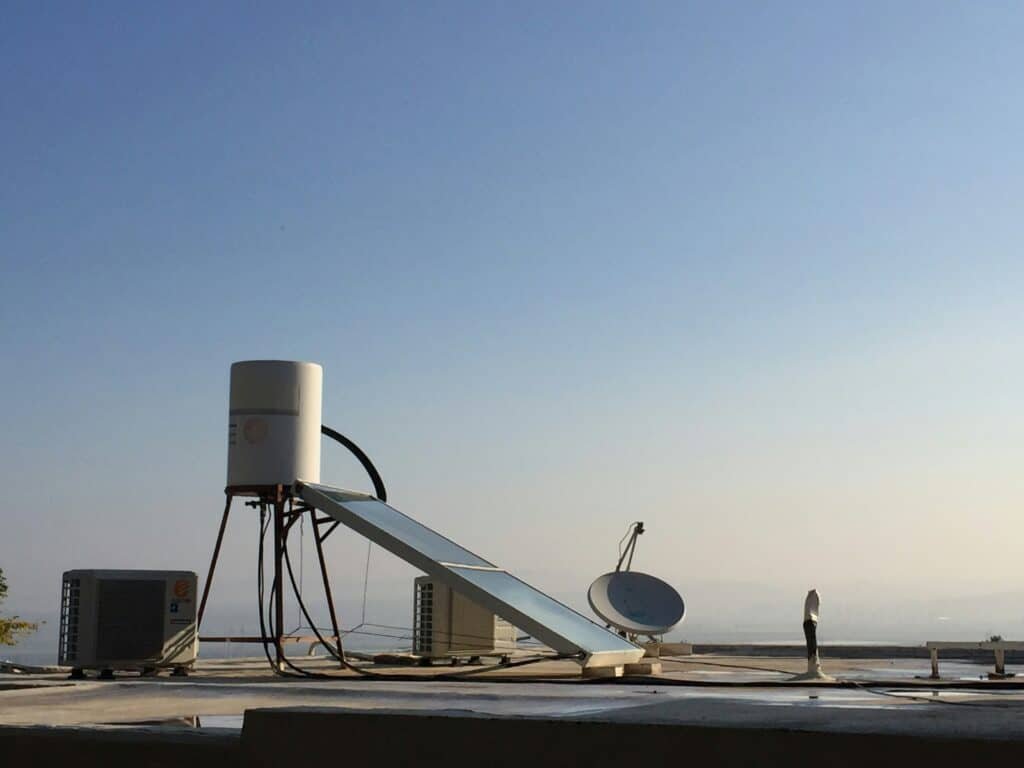
The tank sits above the collector and circulation happens without a pump. Simple and reliable, with freeze exposure that rules them out in cold climates.
Usable sun hours, not daylight hours
Collectors need useful irradiance, not merely light. The same distinction applies here as on the electric side of a system.
Tank Size and Why Bigger Is Not Better
Tank volume between one and one and a half times daily use covers a normal day with some buffer for a cloudy one. Past that, the returns fall away quickly.
An oversized tank is a permanent heat loss. More surface area means more standing loss every hour of every day, including the days you did not need the extra volume.
It also dilutes the stored temperature. The same collected heat spread through a larger volume arrives at a lower temperature, which can leave the backup working harder than a smaller tank would.
Most systems carry an electric element or a boiler loop for exactly that reason, and whether solar water heaters need electricity sets out what depends on power.
The Winter Case Is the Design Case
Winter brings the three problems together: colder mains water, lower sun, and shorter days. The temperature rise goes up exactly as the available heat goes down.
Freeze protection matters more than output in a cold climate, because a frozen collector loop is damage rather than a bad week. The mechanisms are covered in whether solar water heaters work in winter.
A system sized on July figures will run short from November onward. Sizing on the winter case and accepting summer surplus is the usual compromise.
Surplus has its own consequence, since a stagnating collector in midsummer runs hot with nowhere to put the heat. Component lifespan reflects that, which how long solar water heaters last goes into.
What Trips People Up
Guessing daily hot water use
Shower length and laundry habits move this figure more than household size does. A week of rough logging beats an assumption.
Using an annual average mains temperature
The average describes no actual month. February is the month the system has to survive.
Sizing the tank to the collectors
The tank serves the household’s daily draw, not the collector’s peak output. Those are two different numbers.
Treating a pool heater as the same problem
Pool heating works on a large volume and a small rise, which is almost the reverse case. That sits with solar pool heaters instead.
Forgetting the pipe run
A long uninsulated run between collector and tank loses heat on every circulation. Insulation on that run is the cheapest output you can buy.
Estimating Daily Hot Water Honestly
Daily gallons is the input that moves the answer most and the one people guess hardest. Household size predicts it poorly, because habits vary more than headcount does.
Showers dominate for most homes. A low-flow head and a long shower can use more than a high-flow head and a short one, so the fixture rating alone settles nothing.
Laundry and dishwashing add a lumpy pattern rather than a steady draw. Two loads on a Saturday is a different demand shape from the same volume spread across a week.
The simplest honest method is a week of rough logging. Note shower minutes and flow rate, count loads, and add a modest allowance for hand washing and cleaning.
Where the figure is still uncertain, size on the higher end and let the backup carry the gap. Undersizing a collector array is harder to fix later than slightly oversizing it.
Where the Heat Escapes Before You Use It
The system losses input covers more than the collector. Pipe runs, tank standing loss and the heat exchanger all take a share before hot water reaches a tap.
Pipe insulation is the cheapest recovery available, and the run between collector and tank is the one that matters most. An uninsulated run loses heat on every circulation, in both directions.
Tank insulation quality varies more between products than the specification sheets suggest. Standing loss runs every hour of the year, including the hours the collectors contribute nothing.
A long run to a distant bathroom wastes water as well as heat, since the cold slug in the pipe goes down the drain while someone waits. That is a plumbing layout problem rather than a collector one.
Recommended Reading
Collector choice, winter behavior and system lifespan are the three questions that follow a sizing figure, and the answers interact.
What This Calculator Cannot Tell Anyone
It cannot give you your site’s solar resource. Usable sun hours vary by location, orientation and shading, and the figure you enter decides the answer.
It also cannot design the freeze protection. Whether a site needs a drainback arrangement, an antifreeze loop or neither is a local decision with real consequences for getting it wrong.
Solar Water Heater Sizing FAQ
How does a solar water heater sizing calculator work?
It turns daily gallons and your temperature rise into BTU per day using the heat capacity of water, then divides by the collector’s daily output per square foot. It also suggests a tank volume from daily use.
How much collector area does a household need?
It depends on daily use, temperature rise and collector type, which is why the figure is calculated rather than quoted. Evacuated tubes need less area than flat plates for the same heat.
What temperature rise should I use?
Target tank temperature minus incoming mains temperature, taken for your coldest month rather than the annual average. That is the condition the system has to meet.
How big should the tank be?
Commonly one to one and a half times daily use. Going larger adds standing heat loss and spreads the collected heat through more water at a lower temperature.
Will it cover all my hot water?
Rarely all of it year-round, and a backup element or boiler loop is normal rather than a shortcoming. The design question is what share the collectors carry in the worst month.
Flat plate or evacuated tube?
Flat plates cost less per square foot and suit mild climates, while evacuated tubes hold output through cold and wind for a higher price. Climate usually decides it before budget does.