Technically yes, and practically it buys you a few miles rather than a charge, which makes it an emergency tool instead of a charging method. Charging an EV with a portable power station runs into a capacity mismatch that no amount of clever wiring fixes: the car’s battery is an order of magnitude larger than the station’s.
That mismatch is worth understanding before buying anything for this purpose. Our guide to what a portable power station can run covers the loads these units are actually built for.
| What you want | Realistic? | Why |
|---|---|---|
| Full charge from empty | No | Car pack dwarfs station capacity |
| Enough range to reach a charger | Yes, sometimes | A few miles is achievable |
| Daily commute charging | No | Station would need recharging daily too |
| Emergency roadside top-up | Yes, with caveats | Slow, and the station must be large |
| Charging a plug-in hybrid | More plausible | Much smaller battery |
| Off-grid cabin EV charging | No | Needs a fixed system, not a portable unit |
Quick Answer
A large station can put a few miles into a car through the vehicle’s Level 1 cord. It cannot meaningfully charge a depleted pack, because the pack holds many times the station’s total capacity. Treat it as a way to reach a real charger, not as a charger.
The Capacity Problem in Plain Terms
An EV battery is measured in tens of kilowatt-hours. Portable power stations are measured in hundreds of watt-hours to a few kilowatt-hours.
That is a difference of roughly an order of magnitude at the top of the station range, and more than that for mid-sized units. Emptying a station entirely into a car moves the state of charge by a small percentage.
The arithmetic is unforgiving because it is just division. Station capacity divided by the car’s consumption per mile gives you the miles gained, and for most stations that is a single-digit number.
Our guide to how many watt hours you need covers doing that division with your own figures rather than a generic example.
What Actually Works in Practice
The realistic use is getting an immobilized car to a charger. A few miles of range is the difference between a tow truck and driving to a station yourself.
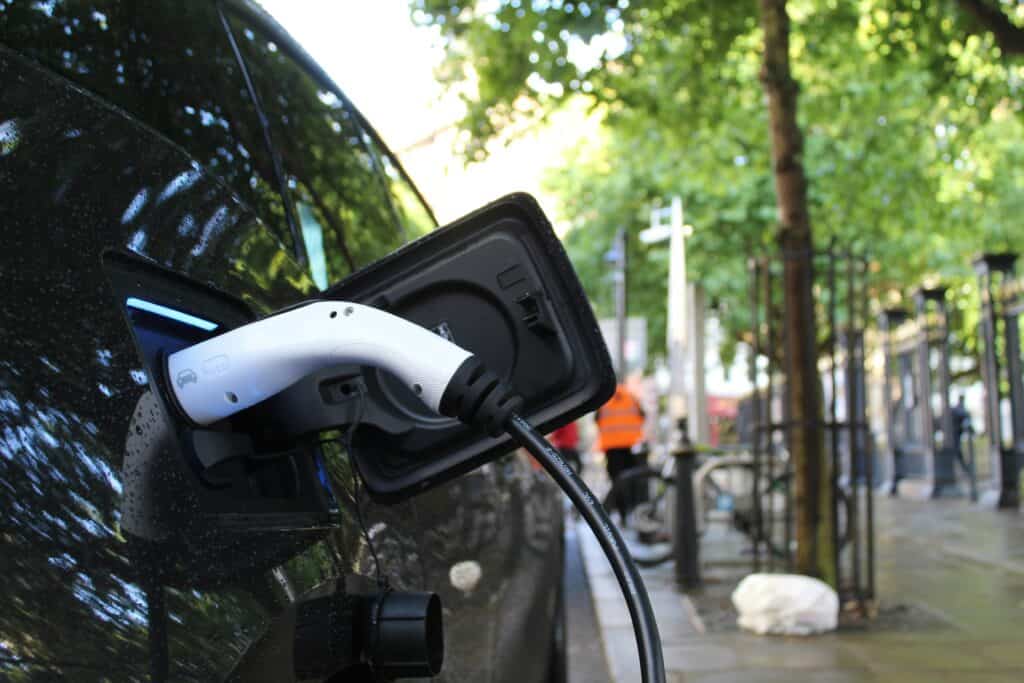
For that, the station needs a pure sine wave inverter with enough continuous output to satisfy the car’s Level 1 cord, which draws steadily for as long as it is connected. Modified sine wave units are not suitable.
The session will be slow, and the station will empty before the car is meaningfully full. Both of those are expected rather than signs of a problem.
Our roundup of portable power stations under two thousand dollars covers the larger end where this becomes possible at all, and our guide to sizing a portable power station covers matching output to a continuous load.
Why the Inverter Rating Matters More Than Capacity Here
Continuous output, not peak
Level 1 charging is a sustained draw for hours. Peak or surge ratings are irrelevant; the continuous figure is the one that has to clear the cord’s requirement.
Pure sine wave only
EV charging cords contain control electronics that expect a clean waveform. Modified sine wave output can cause the cord to refuse to start or to fault partway through.
Thermal endurance
Running an inverter near its continuous rating for hours generates heat. Units that manage brief kitchen-appliance loads well can throttle or shut down under a long charging session.
Ground and fault detection
Charging cords check for a proper ground reference before energizing. Some station outputs do not present one the cord accepts, and the session never starts.
Where a Plug-In Hybrid Changes the Answer
Plug-in hybrid batteries are a fraction of a full EV’s. Against a small pack, a large station represents a much larger share of a full charge.
The gasoline engine also removes the stakes. Arriving at a low charge means using fuel rather than being stranded, which changes what counts as an adequate top-up.
So the same station that is nearly pointless on a full EV can be genuinely useful on a plug-in hybrid. Worth doing the division for your specific vehicle rather than accepting a general answer.
What to Use Instead for Each Real Need
For an off-grid cabin, the answer is a fixed system with a properly sized array, battery bank, and inverter. A portable unit is the wrong architecture, not just an undersized version of the right one.
For home charging without new wiring, a plug-in Level 2 unit on an existing 240 volt outlet does far more than any station will. Our roundup of portable EV chargers for 240 volt outlets covers that path.
For outage resilience where you also want the car to be usable, a whole-home approach is the fit. Our roundup of solar generators for home backup covers that class of equipment.
And if the concern is running out of range on the road, a portable Level 1 cord plus knowledge of nearby charging beats carrying a heavy battery that yields a few miles. Our comparison of a portable power station versus a generator covers the broader tradeoff between these tools.
If You Are Going to Try It Anyway
- Check the continuous inverter rating against the cord’s draw. Not the surge rating.
- Confirm pure sine wave output. Modified sine wave will likely fault the cord.
- Use the car’s own Level 1 cord. Set it to its lowest current selection if it offers one.
- Expect the station to empty. Calculate the miles you will gain beforehand so the result is not a surprise.
- Keep the station ventilated. Hours at high continuous output generates real heat.
- Do not chain adapters. Every additional connection is a resistance point under sustained load.
- Stop if anything gets hot. Warm connectors under a long draw are a failure in progress.
The waveform requirement is the part most worth checking before you buy anything. Our comparison of pure versus modified sine wave inverters covers why a charging cord cares, and our roundup of power inverters for solar systems covers continuous ratings in the class of equipment that could sustain this kind of load.
Frequently Asked Questions
Can you charge an EV with a portable power station?
Yes, but only to gain a few miles. An EV pack holds many times what even a large station stores, so emptying the station moves the state of charge by a small percentage. It is a way to reach a real charger rather than a charging method.
How many miles will a power station add?
Divide the station’s usable capacity by your car’s energy consumption per mile. For most stations that produces a single-digit figure. Do the division with your own numbers, since vehicle efficiency varies considerably.
Does it need a pure sine wave inverter?
Yes. EV charging cords contain control electronics that expect a clean waveform and a proper ground reference. Modified sine wave output commonly causes the cord to refuse to start or to fault mid-session.
What inverter rating do you need?
Enough continuous output to cover the cord’s sustained draw, with headroom. Peak and surge ratings do not apply here, because Level 1 charging is a steady load held for hours rather than a momentary spike.
Is it different for a plug-in hybrid?
Considerably. A plug-in hybrid battery is a fraction of a full EV pack, so the same station represents a much larger share of a charge. The engine also removes the risk of being stranded, which lowers the bar for a useful top-up.
Can you charge a power station from the car and back again?
There is no point. Every conversion loses energy, so moving charge from the car to the station and back leaves you with less than you started with. Use the car’s own outlets for what they are for and leave the pack alone.
Would this work for an off-grid cabin?
No. A cabin charging a vehicle needs a fixed array, a battery bank, and an inverter sized for a continuous load, which is a different architecture rather than a bigger portable unit. Portable stations are built for short-term, small-load use.
Is it safe to leave it charging unattended?
Not advisable. The station runs near its continuous limit for hours, which produces heat, and any warm connector under that load is a developing fault. Stay within earshot and check the connections periodically.