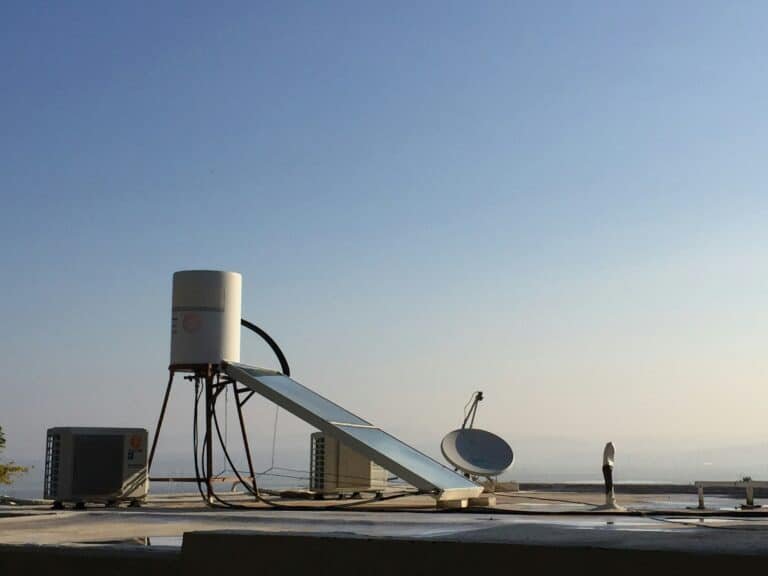

Do solar water heaters need electricity is a question with two correct answers, because the two families of system differ completely on this point. An active system needs a small amount of power to run a pump and a controller. A passive system needs none at all.
Then there is the backup heater, which is a separate matter and often the largest electrical load in the whole setup.
Our guide to whether solar water heaters work in winter covers why that backup exists in the first place.
Quick Answer
Active systems need modest power for the circulation pump and the differential controller. Passive thermosiphon and integral collector systems need none. An electric backup element uses far more than either, and whether it runs is what decides your bill.
Key Takeaways
- Passive systems run on convection and need no power.
- Active systems need power for a pump and a controller.
- The pump draw is small compared with heating water.
- An electric backup element is the real load.
- A photovoltaic powered pump removes the grid dependence.
- In an outage, a passive system keeps working.
- Freeze protection on some designs depends on power.
| System type | Needs power? | What for |
|---|---|---|
| Thermosiphon | No | Convection moves the water |
| Integral collector storage | No | Tank and collector are one unit |
| Active direct | Yes, small | Pump, controller |
| Active indirect, antifreeze loop | Yes, small | Pump, controller |
| Drainback | Yes, small | Pump, controller, drain logic |
| Photovoltaic pumped | Its own supply | Small dedicated panel |
| Any system with electric backup | Yes, significant | Heating element |
| Any system with boiler backup | Small | Boiler controls and pump |
Do Solar Water Heaters Need Electricity in a Passive Design?
How convection does the work
Water expands as it warms, so heated water rises on its own. A thermosiphon system puts the tank above the collector and lets that movement circulate the loop.
Integral collector storage goes further
Here the tank is part of the collector, so there is no loop to circulate. Sunlight heats a reservoir directly and mains pressure pushes the hot water to the taps.
What you give up
Passive designs put weight on the roof and limit where the tank can go. They also suit mild climates far better, because freeze protection is harder without active control.
What you gain
Nothing to fail and nothing to power. In a region without hard freezes, that is a strong argument.
Do Solar Water Heaters Need Electricity for the Pump and Controller?
Active systems do, and the amount is modest. A small circulator and a low-power controller are the whole electrical demand of the solar side.
The controller is the brain. It compares a sensor at the collector with a sensor at the tank and runs the pump only when the collector is the hotter of the two.
That logic is what makes an active system efficient. Running the pump when the collector is cold would move heat out of the tank and onto the roof.
Pump power is small relative to the energy the system collects. The point of the design is that a little electricity moves a lot of heat.
The Backup Element Is the Real Load
Almost every system carries a backup, because the sun does not supply hot water on demand. That backup is usually an electric element in the tank or a boiler feeding it.
An electric element uses far more power than the pump ever will. Heating water electrically is energy intensive, which is the whole reason for having solar collectors.
How often it runs is the figure that matters on a bill. A well sized system in a sunny climate leaves the element idle for much of the year, and an undersized one leans on it constantly.
Timers and controls change this considerably. Our guide to how time of use rates affect solar covers scheduling a backup element against tariff periods.
Running the Pump From a Panel Instead
A photovoltaic powered pump is the neat solution to the grid dependence. A small dedicated panel drives a direct current circulator, with no mains connection and no controller in the usual sense.
The logic becomes self-regulating. Sun on the collector means sun on the small panel, so the pump runs when there is heat to move and stops when there is not.
That removes the controller as a failure point and removes the system from your electricity supply. It also means the pump speed follows the light rather than a setpoint.
Our guide to running solar panels without a battery covers direct drive arrangements of this kind.
What Happens in a Power Outage
- Passive systems carry on. No power, no dependency.
- Active pumps stop. Collection pauses until power returns.
- Stored hot water remains available. Mains pressure delivers it.
- The backup element stops too. So the tank cools without the sun.
- Drainback logic may need power. Check the design.
- Stagnation becomes the risk. A hot collector with no circulation.
That last point is the one worth planning for. An active collector sitting in full sun with a stopped pump reaches high temperatures, which stresses seals and degrades heat transfer fluid.
A long summer outage is therefore worth covering the collector for. Our guide to preparing for a power outage covers the broader household side.
Freeze Protection and Power
Some freeze protection strategies depend on electricity, which makes an outage in winter a different problem from one in summer. Recirculation is the clearest example.
A system that protects itself by circulating warm tank water through the collector during a cold night cannot do that without a pump. A power cut during a hard freeze removes the protection.
Antifreeze loops and drainback designs are less exposed, because the protection is physical rather than active. That is one reason they dominate in cold regions.
Our guide to winterizing a solar system covers the seasonal tasks that go with each protection method.
What to Check on the Spec Sheet
Three figures tell you the electrical story of a system, and none of them is the headline. Find them before you compare models.
The circulator rating comes first. It is a small number and it runs for many hours a year, so it is the one ongoing draw the solar side imposes.
Controller standby is second and is easy to miss. A controller draws a trickle continuously, all year, whether the pump is running or not.
The backup element rating is third and dwarfs both. That figure, multiplied by how often the element actually fires, is the whole electrical cost of the installation in practice.
Together those three explain why two systems with identical collectors can cost very different amounts to run. The difference is almost never the pump.
Climate and sizing drive how often the element fires, which is why the same model behaves differently in two regions. A system sized for its location leaves the element idle for long stretches.
Our guide to reading a solar spec sheet covers the habit of looking past the headline rating.
Related Reading
Frequently Asked Questions
Do solar water heaters need electricity?
Active systems do, for a small circulation pump and a differential controller. Passive thermosiphon and integral collector systems need none at all, because convection moves the water. Any system with an electric backup element uses much more power for that than for the solar side.
How much power does the pump use?
Little, relative to what the system collects. A small circulator and a low-power controller are the whole electrical demand of the solar loop, which is the point of the design.
Can a solar water heater work without any power at all?
Yes, if it is a passive design. Thermosiphon systems put the tank above the collector and let heated water rise, and integral collector systems combine tank and collector so there is nothing to circulate.
Will I still have hot water in a power cut?
Whatever is already in the tank stays available, because mains pressure delivers it. An active system stops collecting until power returns, and the backup element stops as well, so the tank cools without being replenished.
Is the backup element necessary?
In most climates something has to cover the days the sun does not. That backup can be an electric element or a boiler, and how often it runs is what shows up on the bill.
Can I run the pump from a solar panel?
Yes, and it is an established arrangement. A small dedicated photovoltaic panel drives a direct current circulator, so the pump runs when there is sun to collect and stops when there is not, with no mains connection.
Does an outage put the system at risk?
It can, through stagnation. An active collector in full sun with a stopped pump gets very hot, which stresses seals and degrades heat transfer fluid, so covering the collector during a long summer outage is worthwhile.
Does freeze protection need power?
It depends on the method. Recirculation protection needs a working pump and fails in a winter outage, while antifreeze loops and drainback designs protect themselves physically and are far less exposed.