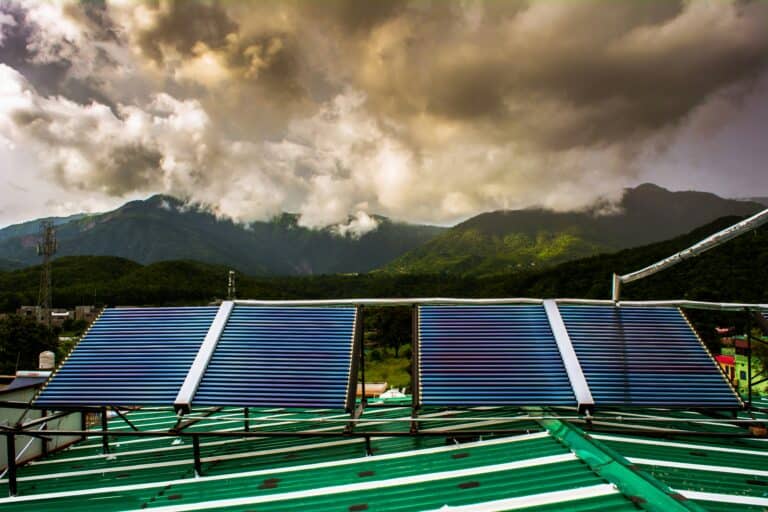

Cooler, during the day, and by a useful margin. Solar makes a roof cooler because the panels intercept sunlight that would otherwise land on the roof surface, and air moving through the gap underneath carries much of that heat away.
The effect is large enough to have been measured rather than merely argued about. Our guide to how hot is too hot for solar panels covers the temperature question from the panel’s side.
| Finding | What was measured |
|---|---|
| Ceiling temperature during the day | Around 5 degrees Fahrenheit cooler under panels than under exposed roof |
| Heat reaching the roof | Reduced by roughly thirty-eight percent |
| Mechanism | Panels absorb the radiation, wind between panel and roof removes much of the heat |
| Tilted against flush mounting | Tilted performs better, because the air gap allows circulation |
| At night | Panels hold accumulated heat, which reduces winter heating demand |
| Net across a year | In a mild climate, winter heating and summer cooling benefits roughly offset |
| Value of the cooling | Comparable to a five percent discount on the panels over their life |
Quick Answer
Panels shade the roof and the gap beneath them vents heat, so the ceiling underneath runs cooler by day. Tilted arrays do this better than flush-mounted ones because air can move. At night the panels retain heat, which helps in winter and roughly cancels the summer gain across a mild year.
Why Shading a Roof Is Not the Whole Story
Blocking sunlight is the obvious part. The panel intercepts radiation that would otherwise be absorbed by the roof covering.
The less obvious part is what happens to that energy afterward. The panel gets hot, and a hot object sitting directly on a roof would simply move the heat along.
What prevents that is airflow. Much of the heat is removed by wind blowing between the panels and the roof, which carries it away rather than into the building.
That is why the gap matters as much as the shade does. Our roundup of solar panel tilt mounts covers the hardware that creates it.
Why Tilt Beats Flush Mounting Here
Tilted panels outperform flush-mounted ones for roof cooling, because tilting opens a space that air can move through.
A panel lying nearly flat against the roof restricts that circulation, so heat has fewer routes out and more of it ends up in the roof assembly.
This runs in the same direction as panel efficiency, since a cooler panel produces more. The two benefits are not in tension.
It also means the cooling benefit is not uniform across installations, and a tightly flush array delivers less of it. Our guide to whether panels can sit flat on a roof covers the trade in full.
The Size of the Effect
Measurements on a building with a rooftop array put the ceiling around 5 degrees Fahrenheit cooler beneath the panels than beneath an exposed section of the same roof.
On the same building, the panels cut the heat reaching the roof by roughly thirty-eight percent, which is a substantial fraction of the load an air conditioner would otherwise handle.
Expressed financially, the cooling saving worked out comparable to a five percent discount on the price of the panels across their lifetime.
Another way to put the same figure is that the array behaves as though it generated about five percent more electricity than it actually does.
Those figures came from one building in one climate, which is the limit on reading across to your own roof. The shading benefit is largest where the roof was performing worst to begin with.
A dark covering over a poorly ventilated attic has a great deal of heat gain available to remove. A light covering over a well-insulated, well-vented assembly has far less, so the same array buys less there.
That is the sensible way to hold the number: as a demonstration that the effect is real and measurable, rather than as a figure to apply to any house. Our guide to what solar panel efficiency means covers the output side of that comparison.
What Happens After Dark
The panels hold heat they accumulated during the day and release it slowly, which works in your favor in winter by reducing heating demand.
In a mild climate those two effects roughly cancel. Summer cooling benefit and winter heating benefit came out close to offsetting each other in the climate where this was measured.
In a hot climate with a long cooling season, the summer benefit dominates and the winter effect matters less.
In a cold climate the reverse applies, and the nighttime retention is the part worth having. Our roundup of solar attic fans covers the other route to moving heat out of a roof space.
What This Does Not Mean
It does not mean panels replace insulation. Attic insulation and ventilation do far more for a building’s thermal performance than shading the covering does.
It does not mean the roof covering lasts longer. Reduced heat and ultraviolet exposure is plausibly helpful and is a separate claim from the temperature measurement.
It does not apply evenly to every roof. Color, existing insulation, ventilation and climate all change how much the shading is worth.
And it is not a reason to install solar on its own, since the cooling is a side benefit rather than the point. Our comparison of ground mount and roof mount solar covers the case where the roof is left out of it entirely.
Getting the Most of It
- Keep the gap. Tilt and standoff height are what let air carry heat away.
- Do not block the underside. Skirting an array for appearance restricts the airflow doing the work.
- Sort the attic out separately. Insulation and ventilation are the larger levers.
- Expect more benefit on a hot roof. Dark, poorly ventilated roofs have more to gain.
- Treat it as a bonus. Size and justify the system on generation.
- Remember the winter side. In a cold climate the nighttime retention is the useful half.
Worth reading next: our guide to how far apart panels should be mounted covers the spacing that sets airflow across an array, our guide to whether solar panels need servicing covers keeping the array working, and our guide to choosing solar panels covers the decisions ahead of all of this.
Frequently Asked Questions
Does solar make a roof hotter or cooler?
Cooler during the day. The panels intercept sunlight that would otherwise be absorbed by the roof, and air moving through the gap underneath carries much of the resulting heat away. Measurements have put the ceiling beneath an array around 5 degrees Fahrenheit cooler than beneath an exposed roof.
How much heat do panels actually block?
On the building where this was measured, the panels reduced the heat reaching the roof by roughly thirty-eight percent. That is a meaningful share of the load a cooling system would otherwise carry, though the figure depends on roof color, insulation, ventilation and climate.
Is the cooling worth money?
It was quantified as comparable to a five percent discount on the panels across their lifetime, which is the same as saying the array behaves as though it produced about five percent more electricity than it does. It is a side benefit rather than a reason to install.
Do flush-mounted panels cool a roof as well?
Less well. Tilting opens a space air can move through, and that airflow is doing much of the work. A panel lying close to the roof restricts circulation, so more heat ends up in the roof assembly instead of being carried off by wind.
What happens at night?
The panels release heat they gathered during the day, which reduces heating demand in winter. In the mild climate where this was measured, the winter heating benefit and the summer cooling benefit came out roughly offsetting each other across the year.
Will solar lower my cooling bill?
Partly, through two separate routes. The electricity offsets what the air conditioner draws, and the shading reduces how much heat the roof passes into the building in the first place. How much the second route is worth varies considerably with the building.
Does this mean I need less insulation?
No. Attic insulation and ventilation do considerably more for thermal performance than shading the roof covering, and shading is not a substitute for either. Treat the cooling effect as an addition to a well-insulated roof rather than a replacement for one.
Do panels make the roof covering last longer?
Reduced heat and sunlight exposure is a plausible benefit, but it is a different claim from the temperature measurement and is not established by it. The clearer statement is that the roof runs cooler by day, which is what was actually measured.