
How long do solar water heaters last depends almost entirely on which part of the system you mean, because the collector on the roof and the pump in the loop are not in the same league. The collector is the durable half. Everything that moves, circulates or stores is the half that gets replaced.
That split is the useful way to think about the system. One component is a long-term fixture and the rest is a maintenance schedule.
Water chemistry and freeze exposure drive more of the outcome than brand does. Here is how the parts compare.
| Component | Durability | What shortens it |
|---|---|---|
| Flat plate collector | Long | Seal failure, glazing damage, hail |
| Evacuated tubes | Long, tube by tube | Lost vacuum, impact |
| Storage tank | Medium to long | Scale, corrosion, spent anode |
| Circulation pump | Medium | Continuous running, debris |
| Differential controller | Medium | Heat, power surges, sensor faults |
| Heat transfer fluid | Short, a consumable | Overheating, stagnation |
| Anode rod | Short, a consumable | Aggressive water |
| Seals, gaskets, insulation | Short to medium | Heat cycling, sun on exposed pipe |
Why the Collector Outlives Everything Else
It has no moving parts
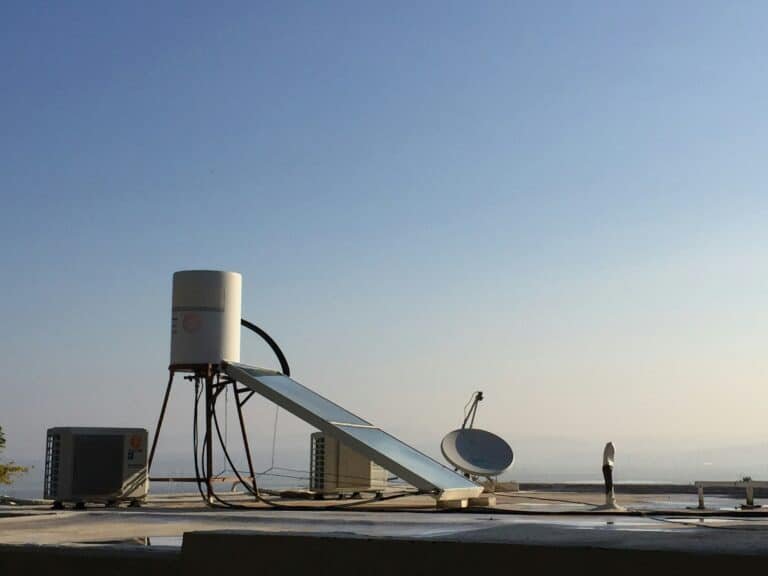
A collector is an absorber plate or a set of tubes behind glazing. Nothing in it wears mechanically, which is why it is the long-lived component.
What does fail on one
Glazing seals perish, moisture gets behind the glass, and the absorber loses efficiency rather than stopping. That decline is slow and often goes unnoticed for years.
Evacuated tubes fail individually
A tube that loses its vacuum stops contributing and the array carries on without it. Replacing one tube is a modest job, which is an advantage over a sealed flat panel.
Hail and impact are the sudden risk
Glazing is the exposed surface and a severe storm can end a collector outright. Our guide to what happens to solar panels in a hailstorm covers the comparable exposure.
The Tank Is Usually the Real Lifespan Question
A solar thermal system stores hot water, and the tank is doing the hardest chemical work in the house. Hot water accelerates corrosion and deposits scale.
Hard water is the main variable. Scale builds on heat exchange surfaces, insulates them, and reduces how much of the collector’s output actually reaches the water.
The anode rod is the sacrificial part protecting the tank lining. It is a consumable, and a tank running with a spent anode corrodes faster from that point onward.
Replacing an anode on schedule extends tank life substantially and costs very little. Ignoring it is the commonest reason a tank goes early.
How Long Do Solar Water Heaters Last in a Freezing Climate?
Freeze exposure is the factor that can shorten the life of a whole system in a single night. A burst collector or pipe is a replacement rather than a repair.
Which is why freeze protection design matters more than component quality in a cold region. A drainback or antifreeze system is built for it and a direct system is not.
Antifreeze is itself a consumable. Heat degrades it over time, and a loop running on spent fluid has less protection than the design assumed.
Our guide to whether solar water heaters work in winter covers the freeze protection designs in detail.
The Parts That Wear Because They Run
An active system circulates fluid whenever the controller says the collector is hotter than the tank. That is a lot of running hours over a year.
Pumps are the clearest wear item in the system. They are also a standard part, so replacement is routine rather than dramatic.
Controllers fail differently, usually at a sensor or from heat. A controller reading a failed sensor runs the pump at the wrong times, which wastes energy and wears the pump.
Passive systems avoid all of this by having no pump or controller at all. Our roundup of solar water heaters covers which designs circulate fluid and which rely on convection.
How Decline Announces Itself
These systems rarely fail loudly. They lose output gradually, and the backup quietly covers the difference, which is why decline often goes unnoticed for a long time.
Backup runtime is therefore the most useful indicator you have. An element or boiler that fires more often than it used to, in the same season and the same household, means the solar side is contributing less.
Tank recovery time is the second sign. Water that takes longer to come back up to temperature after a heavy draw points at scale on the heat exchange surfaces.
A temperature difference that never develops between collector and tank is the third. On a clear day the controller should be running the pump, and a system that stays idle in good sun has a sensor, a pump or a circulation problem.
None of these three signs points at the collector, which is the reassuring part. They point at the parts that were always going to be replaced.
What the Warranty Tells You
Warranties on these systems are split by component, and reading that split is more informative than any general lifespan claim. The collector and the tank usually carry different terms.
Pumps, controllers and fluid are often covered for a much shorter period or excluded. That is the manufacturer describing which parts they expect to be replaced.
Labor is frequently separate from parts. A covered component can still mean a paid visit, which matters for anything on a roof.
Our guide to what a solar warranty covers covers how to read these documents, and the same reading applies here.
Getting the Full Life Out of a System
- Replace the anode on schedule. The cheapest way to extend tank life.
- Check the heat transfer fluid. It degrades and stops protecting.
- Flush scale in hard water areas. Deposits cost output and tank life.
- Keep insulation intact. Sun destroys exposed pipe lagging.
- Watch for stagnation. An idle hot collector cooks its own fluid.
- Service the pump rather than waiting. It is a standard wear part.
- Clear the collector surface. Shade and debris cut output.
Stagnation deserves a note because it is the failure people have not heard of. A collector left in full sun with no circulation, during a vacation or after a pump failure, reaches temperatures that degrade fluid and stress seals.
A system that sits unused needs covering or draining rather than leaving. Our guide to what to do with solar when a property sits empty covers that situation.
How Long Do Solar Water Heaters Last Before Full Replacement?
Systems rarely die all at once. A tank gets replaced, then a pump, then a controller, and the collector carries on through all of it.
The decision point arrives when the collector itself underperforms and the rest has already been renewed. At that stage you are comparing a new thermal system against the alternatives rather than repairing this one.
Thermal and photovoltaic are genuinely different products with different lifespans, and conflating them is common. Our guide to how long solar panels last covers the electricity-generating side.
For pools the calculation is different again, because the collectors are unglazed and the season is short. Our guide to whether solar pool heaters actually work covers that case.
Frequently Asked Questions
How long do solar water heaters last?
The collector is the long-lived part and the tank, pump, controller and heat transfer fluid are the parts that get replaced along the way. A system’s working life is usually set by the tank and by freeze exposure rather than by the collector.
Which component fails first?
The consumables, by design. Heat transfer fluid degrades and the anode rod is sacrificial, so both are scheduled replacements. After those, the pump and controller are the usual wear items.
Does hard water shorten the life of the system?
Yes, noticeably. Scale deposits on heat exchange surfaces and inside the tank, which cuts output and accelerates corrosion. Flushing in hard water areas is maintenance rather than an optional extra.
What is stagnation and why does it matter?
It is a collector sitting in full sun with no circulation, which happens during a vacation or after a pump fails. The collector reaches temperatures that degrade the fluid and stress seals, so an unused system should be covered or drained.
Are evacuated tubes more durable than flat plates?
They fail differently rather than less. A tube that loses vacuum stops working while the rest of the array continues, and replacing one tube is a modest job compared with a sealed flat panel.
Do passive systems last longer?
They have fewer parts to fail, since there is no pump and no controller. That removes the main wear items, though the tank, seals and freeze exposure still apply.
Is a solar water heater the same as a solar panel?
No, and the lifespans are not comparable. A thermal collector heats water directly, while a photovoltaic panel generates electricity, and they are different products with different failure modes.
When should the whole system be replaced?
When the collector itself underperforms and the tank, pump and controller have already been renewed. Before that point, these systems are normally maintained component by component.