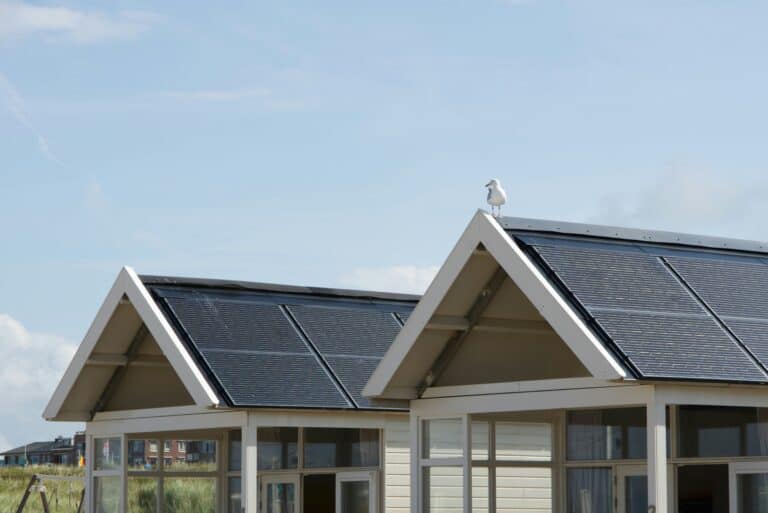
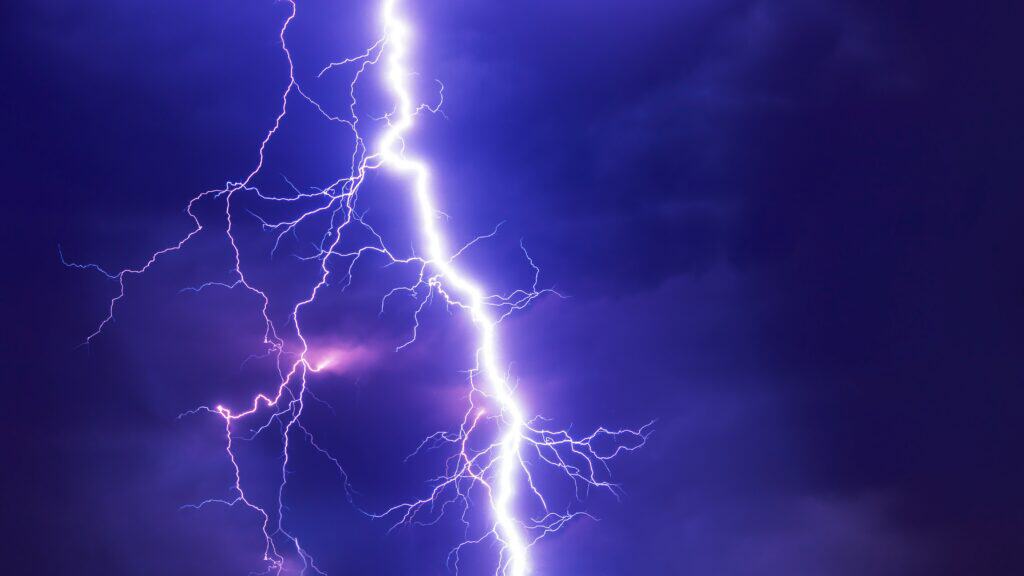
Most lightning damage to solar systems is not a direct strike. It comes from surges induced in wiring by a strike some distance away, which is why protection is about managing voltage rather than intercepting bolts.
This covers how the damage happens, what the layers of protection do, and where each belongs. Our note on whether solar panels need grounding covers the foundation everything else sits on.
Quick Answer
Direct strikes are rare and largely unsurvivable for connected electronics. The common damage is an induced surge, where a nearby strike creates a voltage spike in long cable runs. Grounding plus surge protection devices on the array, battery and AC side is the standard approach. Our roundup of solar surge protectors covers the DC-rated devices that belong on the array side.
Key Points
- Induced surges cause far more damage than direct strikes.
- Long cable runs act as antennas for nearby strikes.
- Grounding and surge protection do different jobs.
- Protection belongs on several points, not one.
- Requirements are set by electrical code and vary by location.
Where Protection Belongs
| Location | What it guards |
|---|---|
| Array side, DC | Controller and inverter inputs |
| Battery side, DC | Bank and battery electronics |
| AC output | Household loads |
| Grounding system | Gives fault current a path |
| Communication cables | Monitoring and network gear |
| Bonding between grounds | Prevents differences in potential |
Induced Surges Do the Damage
A lightning strike releases an enormous electromagnetic pulse, and that pulse induces voltage in any conductor nearby.
Solar systems are unusually exposed because they contain long runs of cable, sometimes across a roof or a field, and length is what determines how much voltage gets induced.
A strike does not have to hit the array or even the property. One several hundred feet away can put a damaging spike into the wiring.
The spike is brief but very high, and it reaches whatever the cable connects to, which is usually the most expensive electronics in the system.
This is why systems with no history of a direct strike still lose inverters and controllers to storms. Our note on what size wire you need covers the runs involved.
Grounding and Surge Protection Differ
Grounding gives fault current a path to earth
It is about safety from energized metal.
Surge devices clamp the voltage spikes
They divert the excess energy safely to ground.
Both of them are needed
Neither one substitutes for the other.
Surge devices need good grounding behind them
Without it they have nowhere to divert anything to.
Protection Works in Layers
A single surge device at one point leaves everything on the other side of it exposed.
The DC side between array and charge controller is the most exposed run in most systems and the usual first place to protect.
The battery side matters because a surge reaching a bank has both the bank’s stored energy and sensitive battery management electronics to work with.
The AC output side protects household loads, and it is the layer most people already have in some form through plug-in protectors.
Communication and monitoring cables are frequently forgotten and offer another path in, since they run alongside power cables. Our roundup of combiner boxes covers units that include surge protection.
Bonding Prevents a Second Problem
Where a system has more than one grounding point, the grounds themselves have to be bonded together.
During a surge, ground is not at a single potential everywhere. Two separate ground rods can sit at very different voltages for a moment.
Equipment connected to both then has that difference across it, which is a way of damaging things that were otherwise protected.
Bonding the grounding electrodes together keeps them at the same potential and removes that path.
This is one of several reasons grounding is treated as a system rather than as individual connections. Our roundup of grounding equipment covers the hardware.
Signs a Surge Already Happened
Surge damage is not always immediate or obvious, which is why it gets misdiagnosed as component failure.
Equipment that stops communicating while still passing power is a common pattern, since the low-voltage communication side is more fragile than the power side.
Intermittent faults appearing after a storm season, with no other change, point the same direction.
A surge device with a tripped indicator is direct evidence something arrived, and it means the device did its job and now needs replacing.
Where several unrelated components fail in a short window, a surge is more likely than coincidence. Our note on how long solar batteries last covers separating wear from damage.
What Protection Cannot Do
Surge protection is genuinely worthwhile and it is not a guarantee.
A direct strike on an array delivers energy far beyond what any surge device is rated to divert, and the realistic expectation is loss of the connected equipment.
Surge devices are also consumable. They degrade with each event they absorb and eventually stop protecting, which is why many have an indicator showing whether they are still functional.
An indicator that has never been checked is not doing its job, and a device that has already sacrificed itself looks identical to one that has not.
Disconnecting a portable or seasonal system before a severe storm remains the most complete protection available, since equipment that is not connected to anything cannot carry a surge. Our roundup of disconnect switches covers isolating a system.
Risk Varies by Location
How much protection is worth installing depends on where the system is.
Lightning frequency varies enormously by region, and areas with frequent summer thunderstorms present a different problem from areas that see a handful of storms a year.
Ground mounts in open ground and arrays on tall structures are more exposed than an array on a low roof surrounded by taller objects.
None of this changes which panels suit a site, since exposure is about placement rather than product. Our guide on choosing solar panels covers that decision separately.
Remote sites deserve extra weight, since the cost of protection is small against the cost of a technician visit to a location that is hard to reach.
Requirements are set by electrical code and vary by jurisdiction, so confirm what applies to your installation with a qualified electrician rather than working from general guidance. Our guide on choosing a solar inverter covers what sits behind that protection.
Common Mistakes to Avoid
Assuming only direct strikes matter
Induced surges from nearby strikes cause far more damage, and long cable runs are what make a system vulnerable.
Treating grounding as surge protection
They do different jobs. Grounding gives fault current a path, surge devices clamp voltage spikes, and each needs the other.
Protecting one point only
Everything on the far side of a single device stays exposed. DC array side, battery side and AC output are separate layers.
Never checking surge device indicators
They are consumable. A device that has already absorbed a surge looks identical to one still working.
Recommended Reading
See our roundup of solar fuses and breakers, our note on what breaks first in a solar system, our roundup of ground mount racking, and our roundup of power inverters.
Solar Lightning FAQ
Do solar panels attract lightning?
They do not attract strikes. What matters is that the long cable runs in a solar system pick up voltage induced by strikes nearby.
What actually causes the damage?
Induced surges in most cases. A strike some distance away creates a voltage spike in the wiring that reaches the electronics.
Is grounding enough on its own?
No. Grounding gives fault current a path to earth. Surge protection clamps voltage spikes. They do different jobs and both are needed.
Where should surge devices go?
On the DC side between array and controller, on the battery side, and on the AC output. Communication cables are worth protecting too.
Will protection survive a direct strike?
Generally not. A direct strike exceeds what surge devices are rated for, and the realistic expectation is losing connected equipment.
Do surge devices wear out?
Yes. They degrade with each event absorbed. Many have an indicator, and it is worth checking after storms.
Should I disconnect before a storm?
For portable or seasonal systems it is the most complete protection available. For a permanent installation it is rarely practical.
Does my location change what I need?
Considerably. Lightning frequency varies by region, and exposed ground mounts face a different risk from a low roof array. Local code applies either way.