
The answer splits cleanly and most people ask the question without knowing the split exists. A washing machine that fills with cold water and uses its motor to turn a drum is a moderate load that plenty of off-grid systems handle. A machine that heats its own water is an entirely different proposition, because the heating element dwarfs everything else the machine does.
Same appliance category, same size drum, and a difference in consumption large enough to decide whether it works at all. Our note on solar charge controllers covers the wider principle.
A Safety Note
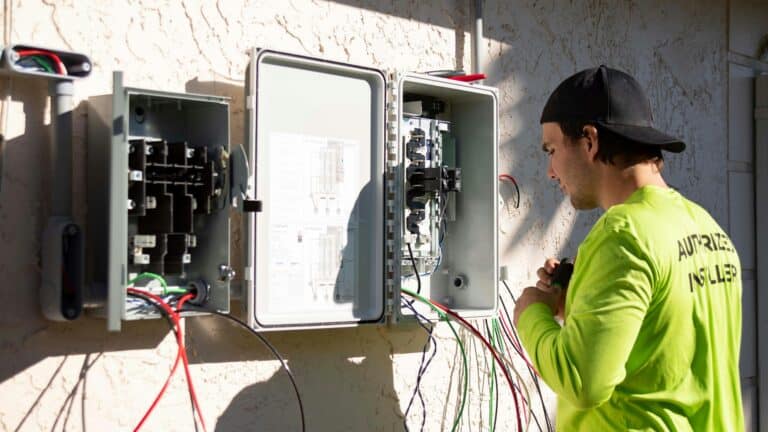
Connecting a washing machine to an off-grid system through household wiring needs a transfer switch installed by a licensed electrician. Machines combining water and electricity also need proper grounding, and that is not an area to improvise.
Quick Answer
A cold-fill machine on a cold wash is manageable on a moderate system. Anything heating water internally requires substantially more capacity, and running the cycle during peak solar production makes either version considerably easier.
Where the Consumption Actually Goes
A wash cycle has three distinct phases and they cost very different amounts.
The motor turning the drum is a modest continuous load, comparable to other motor appliances and well within what a mid-sized inverter handles.
The spin cycle draws more, briefly and at high speed, and it is short enough that the total energy is small even though the instantaneous draw is higher.
Heating water is where the consumption concentrates. A machine bringing a full drum of cold water up to temperature is running a heating element for a substantial part of the cycle, and that single phase can account for most of the total.
Cold Wash Changes Everything
Selecting a cold cycle on a machine that heats its own water removes the heating phase entirely, which turns a demanding appliance into a moderate one.
Modern detergents are formulated to work at low temperatures, and cold washing is effective for ordinary laundry in a way it was not several decades ago.
Where hot water genuinely matters is heavily soiled items, oily stains, and sanitizing. Those are a minority of loads for most households, which makes cold the sensible default with hot reserved for when it is needed.
Our roundup of 12v batteries for solar systems covers choosing the machine itself.
Surge at Startup
Washing machine motors draw a startup surge above their running figure, and the spin cycle produces its own spike as the drum accelerates.
An inverter rated only for the running load can shut down at one of those points, which reads as a fault rather than a sizing problem. Inverter specifications list continuous and surge output separately, and the surge figure is the one that decides whether the machine starts. Our off-grid washing machine guide covers which machines make that arithmetic work.
Older machines with mechanical timers and single-speed motors tend to draw harder at startup than modern variable-speed models, which ramp up more gradually.
Our roundup of power inverters covers matching output.
Run It in the Middle of the Day
This is the single most useful adjustment available and it costs nothing. Running a wash while panels are producing means the load is partly or wholly covered by generation rather than drawn from the battery.
On a clear day with a reasonable array, a midday cold wash can complete without the battery dropping meaningfully, which is a completely different situation from running the same cycle at nine in the evening.
Some machines offer delay start, which lets you load in the morning and have the cycle begin when production peaks. It is a feature worth looking for specifically in an off-grid context.
Our note on what to plug in first covers sequencing loads through a day.
Estimating What a Cycle Costs You
Machine labels state either a wattage or an annual consumption figure, and neither translates directly into what one cycle takes from your battery.
The useful approach is a plug-in energy meter, which measures an actual cycle on your actual machine at the setting you actually use. That single measurement removes all the guesswork, and the meters cost very little.
Failing that, annual consumption figures on the label divided by the assumed number of cycles gives a rough per-cycle number. Treat it as approximate, since the assumed cycle in the test is unlikely to match yours.
Whatever figure you land on, compare it against your usable battery capacity rather than the nameplate capacity, since usable is what you actually have available. Our roundup of production meters covers measuring the other side.
Machine Types Compared
Cold-fill front loaders
Generally the most efficient option, using less water and spinning faster, which also means less drying afterward.
Top loaders with an agitator
Use considerably more water and typically more energy, though older simple designs are sometimes easier on a small inverter.
Portable and compact machines
Small units designed for apartments or RVs draw far less and handle smaller loads, which suits a modest system well.
Manual and hand-crank washers
No electricity at all, which for genuinely small systems or occasional use is a legitimate answer rather than a novelty. Our roundup of power stations for RV camping covers the smaller setups these suit.
Water Supply Matters As Much
Off-grid laundry has a second constraint that grid-connected households never think about, which is where the water comes from and what moving it costs.
A washing machine drawing from a pumped supply means the pump runs during the fill cycles, adding its own draw and its own startup surge on top of the machine’s. Those surges can coincide, which is a common cause of shutdowns that seem unrelated to the wash itself.
Water volume matters too. Front loaders use considerably less water per cycle than top loaders, which off grid means less pumping as well as less heating, and in a system running on stored or hauled water that reduction is worth as much as the electrical saving.
Greywater handling is the other end of it. A wash cycle produces a substantial volume of used water that has to go somewhere, and that plumbing is worth planning before the machine arrives rather than after. Our roundup of solar well pumps covers the supply side.
Drying Is the Harder Problem
Electric tumble dryers are among the most demanding household appliances, since drying is a heating process and heating is where the consumption sits.
Very few off-grid systems run an electric dryer, and those that do usually have substantial capacity and run it only during peak production.
Line drying is the standard off-grid answer, and a high spin speed on the washing machine reduces drying time meaningfully by removing more water mechanically. Heat pump dryers use considerably less than conventional ones and remain a large load.
Washing Machine on Solar FAQ
Can a solar system run a washing machine?
A cold-fill machine on a cold wash is manageable on a moderate system. A machine heating its own water needs substantially more capacity, since the heating element accounts for most of the cycle’s consumption.
How much does a wash cycle use?
It varies enormously with temperature. A cold cycle uses a fraction of what a hot one does on the same machine, because the difference is almost entirely the heating element rather than the motor.
Should I wash on cold?
Off grid, yes, as a default. Modern detergents work well at low temperatures, and hot washing is genuinely useful mainly for heavily soiled items, oily stains, and sanitizing.
What size inverter do I need?
Enough for the running load with headroom for the startup and spin surges. Check the machine’s surge draw against the inverter’s surge rating rather than only comparing continuous figures.
When should I run it?
Midday while panels are producing, so generation covers part or all of the load rather than the battery supplying it. Delay start on the machine makes that easy to schedule.
Are portable machines better off grid?
For small systems, considerably. Compact units designed for apartments and RVs draw far less and handle smaller loads, which suits a modest battery bank without much compromise.
Can I run a tumble dryer?
Rarely. Drying is a heating process and among the most demanding household loads. Line drying is the usual off-grid answer, helped by a high spin speed that removes more water mechanically.
Does a front loader use less than a top loader?
Generally yes, using less water and spinning faster, which also reduces drying time. Some older top loaders with simple motors are easier on a small inverter despite using more overall.
Recommended Reading
See our note on what appliances you can run off grid.
For the wider picture, see our guide to how to choose a solar battery.