
The question sounds like it should have a list for an answer, and it mostly has a principle instead. Appliances that produce heat electrically consume enormous amounts of power. Everything else is comparatively cheap to run.
Once you sort appliances that way, most of the confusion disappears. A laptop, a fridge, lights, and a television together draw less than a single electric kettle, and that ratio is what shapes every off-grid system. Our note on how many watt-hours you need covers the calculation.
A Safety Note
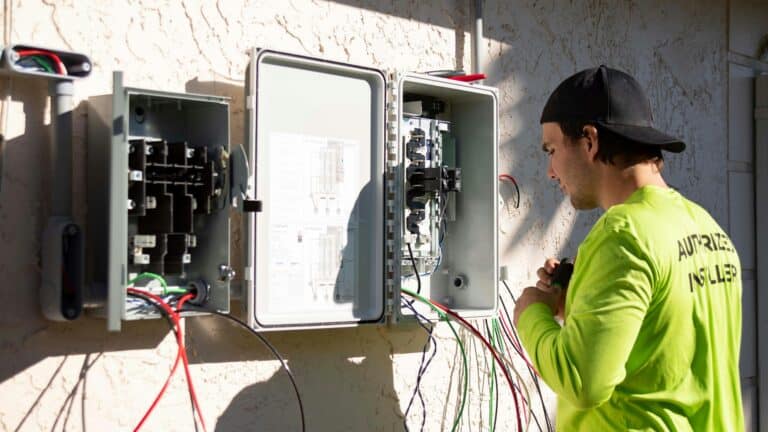
Connecting appliances to an off-grid system through household wiring requires a transfer switch installed by a licensed electrician. Never backfeed power into a home circuit through an outlet, and have any permanent installation done by someone qualified.
Quick Answer
Electronics, lighting, fans, and modern refrigeration run comfortably on modest systems. Anything with a heating element or a compressor for cooling needs substantial capacity, and several are better handled by propane. Solar thermal skips that problem for pool water, as this guide explains.
Why Heat Costs So Much
Electric heating converts electricity directly into heat, and there is no efficiency trick available. Producing a given amount of heat requires a proportional amount of energy, which is why kettles, toasters, hair dryers, space heaters, and electric ovens all draw heavily.
The comparison that makes it concrete: a modern LED bulb draws a handful of watts, and a kettle draws well over a thousand. Running the bulb all evening costs less than boiling water once.
Cooling is a variation on the same problem. Air conditioning and refrigeration move heat rather than creating it, which is more efficient, and compressors still draw substantially more than electronics do.
What Runs Easily
Lighting
LED lighting is close to free in off-grid terms. An entire cabin lit with LEDs draws less than a single incandescent bulb used to.
Electronics
Phones, laptops, tablets, routers, and televisions are all modest loads. A laptop drawing under a hundred watts is one of the cheapest useful things you can run.
Fans
Ceiling and floor fans use a fraction of what air conditioning does, and in many climates they are the practical cooling answer.
Modern refrigeration
A 12V compressor fridge designed for off-grid use is efficient enough for a modest system, and it is still likely to be the largest continuous load you have. Our roundup of 12V refrigerators covers them.
What Needs a Substantial System
Air conditioning is the most demanding common appliance. Compressor cooling draws heavily and runs for hours, which requires both high inverter output and large battery capacity.
Electric water heating is the same problem in a different form. A conventional tank heater is an enormous continuous load, and most off-grid homes use propane, solar thermal, or a wood-fired system instead.
Washing machines and dishwashers are manageable in themselves, and models that heat their own water are not. Cold-fill machines are considerably more workable off grid.
Electric cooking is possible with a large system and it is where most people draw the line, because the same energy through propane costs a fraction of the equipment. Our roundup of solar charge controllers covers that route.
Two Numbers Decide Everything
Every appliance question reduces to a pair of figures, and confusing them is the most common mistake people make when planning a system.
Watts describe how hard something pulls at any given moment, and that number has to sit inside your inverter’s output. Watt-hours describe how much energy it consumes over time, and that has to sit inside your battery capacity.
The two come apart in both directions. A kettle draws enormous watts for two minutes and consumes modest watt-hours. A fridge draws modest watts and consumes far more watt-hours across a day because it never stops. For a whole dwelling, our note on running a cabin entirely on solar covers where heat is the exception. Once you have a load list, our solar sizing calculator turns it into inverter, battery, and array figures.
Sizing an inverter from watt-hours or a battery from watts produces a system that fails in a way that looks mysterious until you separate the two. Our roundup of 24V batteries covers the storage side.
Surge Is a Separate Constraint
Anything with a motor or compressor draws a brief startup surge well above its running figure. Fridges, pumps, air conditioners, and power tools all do this.
An inverter rated comfortably for the running load can still fail on startup, which produces a shutdown that looks like a fault rather than a sizing problem.
Inverter specifications list continuous and surge output separately, and the surge figure is what determines whether an appliance starts at all. Starting one motor load at a time rather than several together avoids overlapping surges.
Our roundup of power inverters covers matching output to loads.
You can check the surge draw your loads need before deciding.
You can see what conversion and idle draw add to the total before deciding.
DC Appliances Skip a Step
Batteries store DC power and most household appliances need AC, which means an inverter converting between them and losing a few percent in the process.
Appliances that run natively on 12V or 24V skip that conversion entirely. For a fridge running continuously, that efficiency difference accumulates meaningfully over a year. Laundry is the awkward one, and our off-grid washing machine guide works through it.
The trade is availability and cost. DC appliances are a smaller market, they cost more, and the range is narrower. Most systems end up mixing DC for the continuous loads and AC for everything else.
Our roundup of DC air conditioners covers one of the more useful examples.
The Order People Actually Add Things
Off-grid systems tend to grow in a recognizable sequence, and knowing it helps you size for where you are heading rather than where you start.
Lighting and phone charging come first, and almost any system handles them. Then a fridge, which is the first load large enough to shape the design and the point where most people discover their battery bank is undersized.
Water pumping usually follows, adding a surge load that reveals whether the inverter was sized for continuous output only. After that come the comfort items: fans, a television, a laptop for work, none of which individually change much.
The last step is where people stall, because it means either accepting propane for cooking and heating or building a substantially larger system to do those electrically. That decision costs more than everything preceding it combined. Our roundup of solar water heaters covers the cheaper route.
Working It Out for Yourself
Every appliance carries a label stating its wattage. Multiply that by the hours you expect to run it, and the result in watt-hours is what the battery has to supply. Once the shortlist is set, building an off grid load list turns those appliances into a daily watt hour figure. Rooftop air conditioning sits in its own category, which our guide covers.
Appliances that cycle rather than run continuously need adjusting. A fridge rated at a given wattage does not draw it around the clock, and manufacturer figures for annual consumption are more useful than the plate rating.
Add everything together, then compare against what your system can store and what your panels put back in a typical day at the time of year you will actually be using it.
Our note on sizing a solar generator covers the arithmetic in more detail.
Off-Grid Appliance FAQ
What is the biggest power drain off grid?
Anything with a heating element, since electric heat cannot be produced efficiently. Kettles, toasters, hair dryers, space heaters, and electric ovens all draw far more than electronics or lighting.
Can I run a fridge off grid?
Yes, and it is usually the largest continuous load in the system. A 12V compressor fridge designed for off-grid use is considerably more efficient than a household model on an inverter.
Is air conditioning realistic?
Only with substantial capacity and high inverter output, and even then running it for hours is demanding. Fans, shade, and insulation do far more per watt in most climates.
Can I use a washing machine?
A cold-fill machine is manageable on a reasonable system. Models that heat their own water are a different proposition, since the heating element is where nearly all the consumption sits.
What is surge and why does it matter?
The brief spike a motor or compressor draws when starting, often several times its running wattage. An inverter sized only for the running load can shut down at startup, which looks like a fault and is a sizing issue.
Are DC appliances worth it?
For continuous loads like refrigeration, the saved inverter conversion adds up over a year. They cost more and come in a narrower range, so most systems mix DC for the big continuous items and AC for everything else.
Should I cook with electricity or propane?
Propane, in most off-grid setups. Cooking is a heat load, and delivering that heat through propane costs a fraction of the battery and inverter capacity electric cooking would require.
How do I know if my system can handle something?
Check the appliance’s running wattage against your inverter’s continuous rating, its surge draw against the surge rating, and its daily watt-hours against your battery capacity. All three have to work, not just one.
Recommended Reading
See our note on propane appliances for off-grid homes, and running power tools off grid, and energy efficient appliances for solar homes, and mc4 tools and crimpers, and solar well pumps, and torque tools for solar terminals, and you run a washing machine on solar.